The price difference between wild and farm-raised kopi luwak is substantial — roughly $100 to $150 per 100 grams for genuine wild product versus $20 to $40 for caged alternatives. But the gap isn’t primarily about marketing. It reflects a production reality that fundamentally cannot be replicated at scale, and a quality difference that shows up clearly in the cup.
How Wild Collection Actually Works
The Asian palm civet (Paradoxurus hermaphroditus) is a nocturnal omnivore that forages through highland forest and plantation edges, selecting ripe coffee cherries based on instinctive preference. Civets are not indiscriminate eaters: they preferentially choose cherries at peak ripeness, which means the beans that enter their digestive tract have already been subject to a first round of quality selection that no human sorter can fully replicate.
A collector working legitimate wild territory rises before dawn to walk the forest floor of known civet routes, gathering deposits from the night’s foraging. The yield from a full morning’s skilled work in good habitat is measured in hundreds of grams of raw material — deposits mixed with seeds, other plant matter, and the civet’s varied diet. After collection, the raw material is washed, sun-dried for several weeks, hulled to remove the parchment layer, sorted by hand to eliminate damaged or contaminated beans, and finally roasted. The total skilled labor investment in a single 100-gram finished package exceeds anything involved in conventional coffee production.
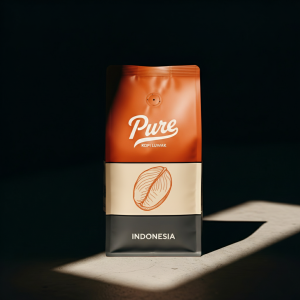
Pure Kopi Luwak
Wild civet coffee from Java. 88.5 SCA cupping score. From $125 for 100g.
This is why genuine wild kopi luwak cannot be produced cheaply: the supply is inherently limited, the labor is skilled and time-intensive, and the yield from collection to finished product is low. Researchers estimate authentic wild production across all of Indonesia amounts to only 50 to 500 kilograms per year. The global market sells thousands of tonnes annually of so-called kopi luwak — a mathematical impossibility if most of it were genuine wild product.
What Caged Production Looks Like and Why It Costs Less
Farm-raised kopi luwak replaces wild collection with captive civets in cages, fed controlled diets of coffee cherries. The labor involved is straightforward: fill food containers, collect waste, process beans. Output is predictable and scalable. There’s no skill required to walk forest at dawn or read civet sign; there’s no seasonal limitation on availability. The cost of production is substantially lower, which is why the price is lower.
PETA’s investigations of Bali farms, including undercover footage from a facility in Catur disclosed publicly in March 2024, documented civets kept in wire enclosures with no opportunity for natural behavior — no climbing, no territory, no dietary variety. Stress behaviors including repetitive circling and bar-biting were visible. These conditions aren’t incidental to caged production; they’re inherent to it. A civet confined to a cage and fed primarily on coffee cherries is, by definition, living in conditions that violate its behavioral needs as a nocturnal forest omnivore.
The Quality Difference in the Cup
The quality gap between wild and farm-raised kopi luwak is measurable and tasted. Published research — including metabolite profiling studies in peer-reviewed journals — has identified distinct chemical signatures in authentic civet-processed coffee: elevated citric and malic acid ratios, specific amino acid profiles from protein breakdown, and complex secondary metabolites associated with the civet’s diverse digestive chemistry. Wild civets eating varied diets produce richer, more complex enzymatic environments than captive animals eating monoculture cherry diets.
The flavor result is consistent with the chemistry. Wild kopi luwak exhibits more complexity, longer finish, and more distinctive character than farm-raised alternatives. The smoothness that characterizes both types — a result of protein breakdown reducing bitter compounds — is present in caged coffee, but the additional dimensions that make wild kopi luwak remarkable are largely absent. A skilled taster can often distinguish them blindly.
When Farm-Raised Sells as Wild
The problem is compounded by labeling fraud. PETA’s 2024 investigation found farms explicitly calling caged product wild-sourced. Industry observers estimate that over 80 percent of kopi luwak sold globally is either completely fraudulent or produced under caged conditions. The price threshold for wild-sourced authenticity sits at roughly $80 to $100 per 100 grams — below that, the economics of genuine wild production are impossible to sustain. Any seller offering wild kopi luwak at tourist market prices is selling something else.
For buyers who want the genuine product — both the quality and the ethical assurance — the key questions to ask any seller are: Can you name the specific collection region? Can you explain the collection method? What is the roast date? And can you explain why your price is what it is? Transparent sellers with real supply chains can answer these questions directly. See our full verification guide at how to authenticate kopi luwak for the complete checklist.
The ethical and quality cases for wild kopi luwak are not separate arguments — they point to the same reality. Civets foraging freely, selecting the cherries they prefer, digesting them in the context of a varied diet, and living without confinement stress produce better coffee. That’s not sentimentality; it’s the chemistry. Our wild kopi luwak is sourced directly from verified highland Java collection, with a supply chain that’s traceable from forest to roaster. For those new to kopi luwak, our overview of pricing and the fraud problem provides further context on navigating the market.
Pure Kopi Luwak
Wild civet coffee from Java. 88.5 SCA cupping score. From $125 for 100g.

Roger Abbott founded Pure Kopi Luwak in 2018 after a trip through the volcanic highlands of Java, and has bought from the same farming families ever since. He only works with collectors of wild civet coffee, never caged. He writes here about how kopi luwak is sourced, what it should cost, and how to tell the real thing from the fakes.