The first specialty coffee most people taste is usually an accident — a pourover from a café that took the order seriously, or a bag of beans gifted by someone who knew more about coffee than the recipient did. What follows that first real cup is often the realization that everything before it was background noise. If you’re at that point of discovery, the question of where to go next deserves a better answer than “expensive coffee with a strange story.”
But here’s the counterintuitive truth: wild kopi luwak can actually be one of the more intelligible premium coffees for beginners, precisely because of the characteristics that make it unusual.
Why Low Bitterness Matters More Than You Think
Most beginners add sugar and milk to coffee because the coffee is bitter. Bitterness is a defense mechanism against overconsumption — the body reads it as a potential toxin signal — and poorly extracted or low-quality coffee amplifies it significantly. The progression from “coffee with milk and two sugars” to “black coffee” typically happens as people learn to distinguish bitterness from other qualities and find coffees where bitterness doesn’t dominate.
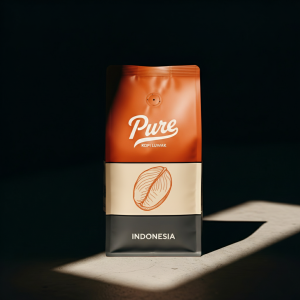
Pure Kopi Luwak
Wild civet coffee from Java. 88.5 SCA cupping score. From $125 for 100g.
Wild kopi luwak shortens this learning curve because it has measurably lower bitterness than conventional coffee. The civet’s digestive process partially breaks down certain proteins that become bitterness during roasting. The result is a coffee that can be drunk black without requiring the tolerance for bitterness that many specialty coffees presuppose. For a beginner trying to understand what coffee tastes like without the bitterness obscuring everything else, this is pedagogically useful — you’re tasting the underlying sweetness, body, and terroir character more clearly than you would in a conventionally processed Arabica.
The same logic applies to the reduced acidity. Javanese wild kopi luwak has lower citric and malic acid concentrations than conventionally processed beans from identical origins. Acidity, at manageable levels, is desirable in specialty coffee — it contributes brightness and complexity. But for someone still calibrating their palate, sharp acidity can interfere with the ability to perceive other qualities. Kopi luwak’s softer acid profile lets body and sweetness register more clearly. The low-acid profile of kopi luwak is also one reason doctors sometimes recommend it for people with acid reflux who want to continue drinking coffee.
Try the coffee this article is about
Wild-sourced from Java, 88.5 SCA cupping score, free US shipping. From $125 for 100g.
Shop Pure Kopi Luwak →Understanding the SCA Quality Framework
The Specialty Coffee Association uses a 100-point scoring scale to evaluate coffee quality. Only coffees scoring 80 or above receive the “specialty grade” designation. This 80-point threshold covers: clean cup (absence of defects), uniformity, fragrance/aroma, flavor, aftertaste, acidity, body, balance, sweetness, and overall impression. The SCA framework is the industry standard for what “quality coffee” means in objective terms.
Authentic wild kopi luwak from verified sources regularly demonstrates the characteristics that score well on this scale: clean cup, full body, notable sweetness, and balance. Where it differs from coffees that score at the very top of the scale is in the brightness and complexity dimensions — it trades floral aromatics and sharp fruit-forward acidity (the hallmarks of a high-scoring Ethiopian or Kenyan) for smoothness, depth, and length. Neither profile is objectively superior; they’re different expressions of quality. But for a beginner, the smoothness profile is typically more immediately legible than the brightness profile.
Starting with Pour-Over
For a first cup of kopi luwak — or any premium single-origin — pour-over is the clearest format. It requires minimal equipment (a simple dripper, filters, a kettle, a scale), rewards attention to water temperature and ratio without demanding espresso-level precision, and produces a cup that showcases the coffee’s natural character without the pressure-driven intensity of espresso or the heavy extraction of French press.
Use water at 92–93°C, a ratio of 15:1 (water to coffee) by weight, and a medium-fine grind. For 250ml of water, that’s approximately 17 grams of coffee. Pour in a slow spiral starting from the center, allowing a 30-second bloom (the outgassing phase when CO2 escapes from freshly roasted grounds). The full pour should take 2 to 3 minutes. What you’re aiming for in the cup: a clean, golden-brown color, syrupy body when you tilt the cup, and a finish that lingers. That finish length — where the sweetness and earthiness stay present long after swallowing — is the most distinctive characteristic of well-extracted wild kopi luwak, and it’s a useful reference point for evaluating every other coffee you drink afterward.
The Price-Per-Cup Reality
Beginners often stall at the price of kopi luwak: $100–$300 per 100 grams seems like an extraordinary outlay for coffee. But per-cup math changes the picture. At 17 grams per pour-over cup, 100 grams yields approximately six cups. At $125 for 100 grams, that’s about $21 per cup — less than most restaurant wine pours, and less than many craft cocktails. The experience-per-dollar comparison shifts considerably when you calculate it correctly.
More importantly: one 100-gram bag is the correct amount for an introduction. It’s enough to experiment with grind size and ratio, to make the same coffee twice and compare, to taste it at different temperatures, and to understand what you paid for. It’s also enough to share with a second person who can give you a different perspective on what they’re tasting. One bag, brewed carefully over a week, teaches more about premium coffee than a year of drinking commodity beans will. The complete brewing guide covers all methods with specific parameters for beginners. And when you’re ready to order, Pure Kopi Luwak ships whole-bean, roasted to order — the right format for a first serious introduction to what premium wild-sourced coffee actually tastes like.
Pure Kopi Luwak
Wild civet coffee from Java. 88.5 SCA cupping score. From $125 for 100g.
Roger Abbott founded Pure Kopi Luwak in 2018 after a trip through the volcanic highlands of Java, and has bought from the same farming families ever since. He only works with collectors of wild civet coffee, never caged. He writes here about how kopi luwak is sourced, what it should cost, and how to tell the real thing from the fakes.