Tooth enamel is the hardest substance in the human body — harder than bone — but it’s also permanently porous. The outer surface of each tooth is coated in a protein-rich film called the acquired pellicle, which forms naturally from saliva within seconds of brushing. It’s protective. It’s also exactly where coffee tannins bind and cause staining.
If your teeth have yellowed from years of coffee drinking, that staining is sitting in the pellicle — not in the enamel itself, which is why dental polishing can remove it and why the right coffee choice slows the rate of accumulation. Understanding the mechanism tells you both why it happens and what you can actually do about it.
What Tannins Are And Why They Stain
Tannins are polyphenolic compounds found in plants — in tea, red wine, dark chocolate, and coffee. They evolved as a plant defense mechanism (they taste astringent, which discourages animals from eating unripe fruit). In coffee specifically, the dominant tannins are hydrolyzable tannins and condensed tannins (proanthocyanidins).
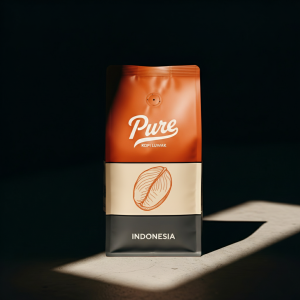
Pure Kopi Luwak
Wild-sourced. Organic. Arabica. From $125.
Tannins stain teeth through two mechanisms. First, they bind directly to the salivary proteins in the acquired pellicle — the “sticky film” that coats teeth — creating a colored complex that adheres to the tooth surface. Second, tannins are chromogens: they enhance the binding and color intensity of other staining compounds, including the melanoidins (dark pigments) formed during the Maillard reaction in coffee roasting.
Research published in the Journal of Dentistry has documented that coffee tannins bind to hydroxyapatite (the main mineral in enamel) with significant affinity — essentially, tannins have a chemical preference for exactly the structure that makes up your teeth. Drinking water immediately after coffee partially rinses tannins before they bind, which is why dentists routinely recommend it.
Roast Level, Brewing Method, And Tannin Content
Here’s a counterintuitive fact: lighter roasts contain more tannins than darker roasts. Roasting degrades polyphenolic compounds including tannins. This means the specialty coffee world’s preference for light roasts — often marketed as more complex and healthful — comes with a tannin tradeoff. A light-roasted Ethiopian natural process coffee, for all its blueberry and wine notes, may stain teeth more aggressively than a medium-dark espresso blend.
Brewing method also affects tannin extraction. Longer contact time and finer grind both increase tannin extraction. French press (long immersion, unfiltered) extracts more tannins than pour over (shorter contact, paper-filtered). Espresso extracts a concentrated shot with high tannin density, but in smaller volume — so total tannin intake per cup may be lower than a large drip coffee.
Cold brew — because cold water is less efficient at extracting tannins and other polyphenols — produces meaningfully lower tannin concentrations than hot brewing from the same beans. If teeth staining is your primary concern, cold brew addresses it at the extraction stage.
Where Kopi Luwak Sits In This
The fermentation that occurs as coffee passes through the civet’s digestive system does something relevant here. Fermentation processes in plant matter generally reduce tannin content — it’s a well-documented phenomenon in food science. Grape fermentation for wine, cocoa fermentation, and tea oxidation all reduce the tannin content of the original plant material.
The 2013 metabolomics study by Udi Jumhawan and colleagues at the Indonesian Coffee and Cocoa Research Institute (Journal of Agricultural and Food Chemistry, 61(33):7994–8001) documented the distinctly different polyphenol and organic acid profile of wild kopi luwak compared to regular Arabica and Robusta. The civet’s proteolytic enzymes break down storage proteins and alter the phenolic compound distribution in ways that no external processing method replicates.
The practical result: kopi luwak’s fermented processing is expected to reduce certain tannin-forming compounds relative to conventionally processed Arabica. This contributes to both its lower astringency (which you taste as smoothness) and potentially a gentler effect on tooth enamel compared to equivalent-strength regular coffee. While specific dental research on kopi luwak’s tannin content compared to regular coffee hasn’t been published, the general chemistry supports the inference.
Minimizing Staining Without Giving Up Coffee
A few practical interventions that actually help:
Drink water immediately after coffee. Rinsing within 30 seconds significantly reduces how much tannin has time to bind to the pellicle. Don’t brush immediately after — the acid in coffee temporarily softens enamel, and brushing within 30 minutes can cause abrasion.
Use a straw. For cold brew especially, a straw reduces direct contact between coffee and front teeth. It looks odd for a hot latte. It’s perfectly reasonable for cold brew.
Choose medium-to-dark roast when staining is a concern. The higher roast temperature degrades more tannins. You sacrifice some acidity-related brightness and certain aromatics, but the trade-off is real.
Consider brewing method. Paper-filtered pour over and cold brew extract fewer tannins than French press or immersion methods. The AeroPress with a paper filter is similarly clean.
Professional cleaning. Tannin staining accumulates in the pellicle layer, not in enamel — a dental hygienist can remove it. Regular cleanings (every 6 months) keep staining manageable even for daily coffee drinkers.
The Premium Coffee Angle
There’s a broader point worth making: the people most concerned about coffee’s effects on their teeth tend to be the same people who drink coffee daily, care about what they’re consuming, and are willing to pay for quality. The intersection of “cares about teeth” and “drinks good coffee” is exactly where kopi luwak fits.
Its modified fermentation profile, lower natural astringency, and the fact that it’s typically brewed in smaller quantities (you’re not downing three large drip coffees because the price point encourages mindfulness) all contribute to a less aggressive cumulative effect on tooth color.
Wild-sourced kopi luwak — the version with the actual fermentation processing that changes the compound profile — is what makes the chemical difference. Farmed versions, where the processing is less controlled, may not demonstrate the same tannin reduction. The broader health profile of kopi luwak and its unique compound markers are tied to wild sourcing and genuine enzymatic processing, not just to the name.
Your teeth will still turn yellow if you drink enough of any coffee. But not all coffees stain equally, and the one that’s been fermented inside a civet for 24 hours turns out to be gentler on your enamel than the one that hasn’t. Coffee is full of surprises like this.
Pure Kopi Luwak
Wild-sourced. Organic. Arabica. From $125.

Roger Abbott is the founder of Pure Kopi Luwak. He has spent over a decade sourcing wild kopi luwak directly from farmers and collectors in the highlands of Java, Indonesia — working exclusively with wild civets, never caged. He writes about specialty coffee, Indonesian origins, and the science behind what makes kopi luwak taste the way it does.
