The first coffeehouse in Constantinople opened in 1554 — two years before the Ottoman Empire peaked under Suleiman the Magnificent — and Turkish coffee culture was so central to civic life that UNESCO recognized it as Intangible Cultural Heritage in 2013. That’s nearly five centuries of unbroken practice for a beverage made with sand, a small copper pot, and extraordinarily fine grounds. Brewing kopi luwak in a cezve is an act of collision between two of the world’s most storied coffee traditions.
The result is remarkable. Turkish preparation’s unfiltered, concentrated extraction produces an intensity that exposes every dimension of a bean’s character. For kopi luwak, whose distinctive chemistry — elevated citric and malic acid, reduced bitter proteins, complex enzymatic by-products documented in published metabolite studies — Turkish brewing captures these qualities with an intimacy that no other method can match. It’s also the most affordable way to experience kopi luwak: a single demitasse requires less than seven grams of coffee.
The Cezve
A traditional cezve (also called an ibrik) is made of copper or brass, sometimes tin-lined, with a long handle and a slightly flared lip. The narrow neck is intentional: it slows the foam’s rise, giving you a fraction of a second to lift the pot before overflow. Copper conducts heat evenly and responds instantly to temperature changes — which is exactly what Turkish coffee preparation demands. An aluminum or stainless steel cezve works but is less forgiving.
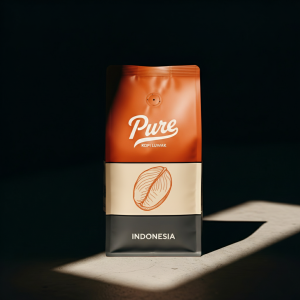
Pure Kopi Luwak
Wild civet coffee from Java. 88.5 SCA cupping score. From $125 for 100g.
Size matters. Use a cezve sized for the number of servings you’re making. A single-serving cezve holds 60 to 75 ml of liquid; brewing one cup in a vessel designed for four means the liquid sits too low for proper foam development. For kopi luwak, a single-serving cezve minimizes waste and maximizes control.
The Grind
Turkish coffee requires a grind finer than espresso — closer to talcum powder than to salt. When you rub it between two fingers, you should feel no texture, only smoothness. Most standard home grinders cannot achieve this fineness. If you have a flat-burr grinder with a wide range, set it at its absolute finest and extend the grind time. Alternatively, a traditional Turkish hand grinder (çekirdek öğütücü) is purpose-built for this consistency.
This matters doubly for kopi luwak. The extremely fine grind maximizes surface area and extraction in the brief cooking window. Under-grinding produces a weak, one-dimensional cup that fails to capture the depth that makes civet-processed coffee worth the price. Grind immediately before brewing; at this fineness, surface area is enormous and oxidation accelerates.
Try the coffee this article is about
Wild-sourced from Java, 88.5 SCA cupping score, free US shipping. From $125 for 100g.
Shop Pure Kopi Luwak →Ratio and Measurement
The traditional measurement is one heaped Turkish coffee spoon (approximately 7 grams) of ground coffee per 60 ml of cold water — a ratio of roughly 1:9, far more concentrated than any filtered method. For kopi luwak, this concentration extracts the full spectrum of the bean’s enzymatic complexity. The result is not the same as espresso despite the small volume; Turkish coffee is unfiltered, meaning all compounds remain in suspension, while espresso pushes water through a compact puck under nine bars of pressure.
Add sugar to the cold water before heating, not after. This is how Turkish coffee achieves its characteristic gloss: the sugar dissolves and caramelizes uniformly as the coffee heats. For kopi luwak, consider drinking it unsweetened the first time — the naturally reduced bitterness of civet-processed beans makes Turkish preparation unusually approachable without sweetener.
The Technique
Combine cold water and coffee in the cezve, stir to integrate, then place over low heat. This is critical: low, steady heat, not high flame. Turkish coffee is coaxed upward, not forced. As the coffee heats, a foam develops across the surface. Watch it carefully.
When the foam begins to rise toward the lip — this takes two to four minutes depending on heat level — remove the cezve immediately. Pour a small amount of foam into each cup first, to reserve it. Return the cezve to heat until it rises again, then pour. Some practitioners repeat this three times for a fuller foam layer; twice is standard.
Allow the cup to rest for sixty to ninety seconds before drinking. The grounds settle during this time. Drink slowly, stopping before you reach the sediment at the bottom. The grounds are not meant to be consumed.
What Turkish Preparation Reveals
Because nothing is filtered out, Turkish kopi luwak captures the bean’s complete chemical profile — including the kahweol, sterols, and fatty acids identified in NMR metabolite studies of civet-processed coffee. The result is a cup of unusual density and persistence. The flavor evolves as it cools, showing layers that a brief sip of hot coffee cannot reveal.
The aroma is intense — earthier and more complex than any filtered preparation of the same beans. If you’ve only experienced kopi luwak through a French press or pour-over, Turkish preparation will feel like a different coffee entirely, even from the same batch. That’s not a flaw; it’s a demonstration of how profoundly brewing method shapes what’s in the cup.
For those new to kopi luwak who want to understand the coffee before exploring traditional methods, our taste profile comparison with regular arabica provides useful context. For sourcing guidance, authentic wild kopi luwak from verified Indonesian origins is essential — the Turkish method’s intensity makes fraudulent or caged-origin product immediately obvious in ways that gentler brewing might obscure. See also our breakdown of the cost and quality differences between wild and farm-raised to understand why source matters especially for concentrated preparations like this.
Pure Kopi Luwak
Wild civet coffee from Java. 88.5 SCA cupping score. From $125 for 100g.
Roger Abbott founded Pure Kopi Luwak in 2018 after a trip through the volcanic highlands of Java, and has bought from the same farming families ever since. He only works with collectors of wild civet coffee, never caged. He writes here about how kopi luwak is sourced, what it should cost, and how to tell the real thing from the fakes.