Vietnam is the world’s largest producer of Robusta coffee — not a footnote to that fact, but the central explanation for why Vietnamese civet coffee and Indonesian kopi luwak are two different products despite sharing the same animal. The Asian palm civet processes what it finds, and in Vietnam’s Central Highlands, what it finds is overwhelmingly Robusta. In Java’s highland farms, it finds Arabica. The civet’s contribution — the enzymatic processing, the smoothing of bitterness, the body modification — is the same biological process in both countries. The coffee going in is not the same, and neither is what comes out.
Understanding this distinction prevents a category error that misleads buyers on both sides: Vietnamese weasel coffee isn’t inferior kopi luwak, and Indonesian kopi luwak isn’t better Vietnamese weasel coffee. They’re the same processing method applied to different species, different terroirs, and different flavor objectives. The comparison is interesting precisely because it isolates the civet’s contribution from the origin variable.
The Robusta vs. Arabica Foundation
Coffea robusta and Coffea arabica are different species with measurably different chemistry. Robusta contains roughly twice the caffeine of Arabica — typically 2.0 to 2.7% by dry weight versus Arabica’s 1.2 to 1.5%. Robusta has lower lipid content and higher chlorogenic acid concentration, which contributes to its characteristic bitterness and the rubbery, nutty harshness that makes unprocessed Robusta unappealing for premium consumption but useful as an espresso component for body and crema.
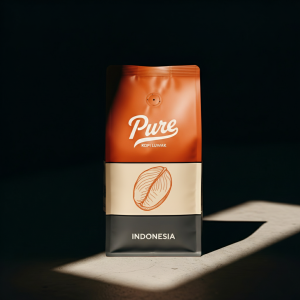
Pure Kopi Luwak
Wild civet coffee from Java. 88.5 SCA cupping score. From $125 for 100g.
When a civet processes Robusta, the proteolytic enzymes that reduce bitter precursor proteins still do their work — and the smoothing effect on Robusta’s characteristic bitterness is arguably more dramatic than on Arabica, precisely because there’s more bitterness to reduce. Comparative chemical analysis documented in the kopi luwak literature found that civet-processed Robusta beans contain significantly elevated levels of caprylic methyl ester and capric acid methyl ester — fatty acid compounds that function as natural flavoring agents. These compounds produce flavor notes not typically found in Arabica-based kopi luwak: a coconut-adjacent sweetness, a mild nuttiness, and what some tasters describe as a pandan-like quality when Vietnamese weasel coffee is brewed from Robusta grown on a grass-and-coffee-cherry-only diet.
The Philippine Connection: Where “Alamid” Actually Comes From
Vietnamese civet coffee is sometimes called “alamid” in export marketing, which is technically incorrect — alamid is the Filipino Tagalog word for the Asian palm civet, and kapé alamíd refers specifically to Philippine civet coffee. Vietnamese weasel coffee is cà phê chồn in Vietnamese. The conflation appears in some international marketing, and it’s worth clarifying because Philippine kape alamid and Vietnamese weasel coffee are meaningfully different products in ways that matter for buyers.
Philippine kape alamid, particularly from the Cordillera mountain provinces of northern Luzon, uses Arabica grown at 1,200 to 1,500 meters — lighter, brighter, and more fruit-forward than Indonesian Javanese Arabica. Vietnamese weasel coffee is predominantly Robusta from the Central Highlands. When all three are compared — Indonesian kopi luwak (Arabica, Java), Philippine kape alamid (Arabica, Cordillera highlands), and Vietnamese weasel coffee (primarily Robusta, Central Highlands) — you’re comparing three different civet-processed coffees with the same animal playing the same biological role in each, and three different results.
Try the coffee this article is about
Wild-sourced from Java, 88.5 SCA cupping score, free US shipping. From $125 for 100g.
Shop Pure Kopi Luwak →The Trung Nguyen Complication
Vietnam’s coffee market is dominated by Trung Nguyen, the country’s largest coffee company, which sells a product called “Legendee” — a simulated weasel coffee produced by treating beans with enzymes to approximate civet processing without any animal involvement. The Legendee Classic blends Arabica, Robusta, Liberica, and Excelsa (the four cultivars grown in Vietnam), while Legendee Gold uses only Arabica. Neither is genuine civet-processed coffee, and neither claims to be — but the product’s market dominance has created widespread consumer confusion about what Vietnamese weasel coffee actually is.
Genuine wild Vietnamese weasel coffee exists and is produced in small quantities from wild civets in forest-adjacent farming areas. It’s rarer than the commercially simulated version and commands a premium domestically. For international buyers, accessing verified wild Vietnamese weasel coffee requires the same diligence as accessing genuine Indonesian kopi luwak: documented sourcing, named farms or collection areas, and a supply chain with traceable provenance.
Flavor Comparison in Practice
Side-by-side, authentic wild versions of Indonesian kopi luwak and Vietnamese weasel coffee express their differences clearly. Indonesian kopi luwak from Java (medium-roasted Arabica) tends toward chocolate, earth, and caramel with a clean, long finish and low bitterness — the classic civet-processed profile on a Arabica terroir that already leans toward these characteristics. The body is full but refined.
Vietnamese weasel coffee from wild-processed Robusta has more structural presence: higher caffeine makes itself felt, the body is heavier, and the flavor notes are bolder and less refined — the civet processing has smoothed the rough Robusta edges significantly, but what remains is a coffee with more presence and less elegance than Javanese kopi luwak. Some drinkers prefer it, particularly those who normally drink espresso or strong Vietnamese-style drip coffee. It pairs well with condensed milk in the traditional Vietnamese preparation style, where the boldness of Robusta-based coffee is an asset rather than a limitation.
Which Is Better?
Neither is better in an objective sense — they’re optimized for different experiences. Indonesian kopi luwak from Java is the right choice for buyers who want the most refined, lowest-bitterness, most elegantly complex expression of civet processing — a coffee to drink slowly, black, at slightly below optimal extraction temperature, where the full body and long finish can be appreciated. It’s the version that most consistently represents what attracted attention to civet-processed coffee in the first place.
Vietnamese weasel coffee is the right choice for buyers who want to understand how the same biological process produces a different outcome on different raw material — or who simply prefer a bolder, higher-caffeine cup. The comparison between the two illuminates the civet’s role more clearly than either alone: the animal’s contribution is consistent, the terroir variable is not. What the civet actually does chemically stays constant; what it has to work with determines the finished cup. That’s the central lesson of comparing kopi luwak across producing countries — and why wild-sourced Javanese Arabica remains the benchmark expression of what the category can achieve at its best.
Pure Kopi Luwak
Wild civet coffee from Java. 88.5 SCA cupping score. From $125 for 100g.

Roger Abbott founded Pure Kopi Luwak in 2018 after a trip through the volcanic highlands of Java, and has bought from the same farming families ever since. He only works with collectors of wild civet coffee, never caged. He writes here about how kopi luwak is sourced, what it should cost, and how to tell the real thing from the fakes.