Java’s coffee harvest season runs roughly from May through October, depending on elevation and cultivar. During those months, the Asian palm civet — a small, solitary, nocturnal omnivore that has shared the island’s highlands with coffee farmers for generations — begins incorporating ripe coffee cherries into its diet. It does not forage in predictable routes. It does not congregate. It moves alone through the forest edge and the plantation rows, consuming cherries when it finds them, depositing the processed beans across a territory that can span several kilometers in a single night’s travel. This is the supply chain of wild kopi luwak. By any conventional agricultural standard, it is spectacularly inefficient. That inefficiency is the entire point.
The Biological Constraints on Production
The Asian palm civet (Paradoxurus hermaphroditus) is listed as Least Concern on the IUCN Red List, with large, widely distributed populations across South and Southeast Asia. The species is not endangered — but it is solitary. Unlike social animals whose behaviors can be organized into production systems, civets operate as individuals, each with an established home range, each foraging independently. Each animal’s processing of coffee cherries is a discrete, unrepeatable biological event.
The consequence for production is direct: you cannot increase wild kopi luwak output by expanding plantation area, because the constraint is not the number of coffee plants. It’s the number of wild civets using those plants, and the fraction of their omnivore diet that happens to be coffee during harvest season. Coffee cherries are one item among many — fruits, small vertebrates, insects — and a wild civet’s cherry consumption per night is governed by availability, competition from other food sources, and its own preferences. No human production target enters the equation.
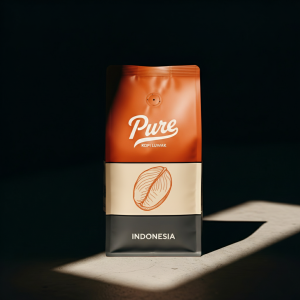
Pure Kopi Luwak
Wild civet coffee from Java. 88.5 SCA cupping score. From $125 for 100g.
The Collection Challenge
After the civet processes the beans and deposits them on forest floor or farm paths, collection begins. Farm workers must physically locate deposited beans — scattered across irregular terrain, often in low light at the edges of agricultural land — clean them of organic debris, and transport them to the washing and drying stage. Unlike a conventional coffee harvest, where workers move systematically through plantation rows, wild kopi luwak collection requires following specific civet movement corridors: areas where the animals’ nocturnal routes pass close enough to accessible farm land that their droppings are recoverable before animals or weather disperses them.
These corridors shift with the animals. A path used heavily in one season may be largely abandoned the next if food sources change or the animal’s range shifts. The collection work requires knowledge of local civet behavior — shelter locations, water sources, preferred farm sections — accumulated over years of observation by the same workers on the same land. This expertise doesn’t transfer easily, can’t be automated, and doesn’t scale in any conventional sense.
Try the coffee this article is about
Wild-sourced from Java, 88.5 SCA cupping score, free US shipping. From $125 for 100g.
Shop Pure Kopi Luwak →Why the Fraud Market Exists
The price differential between wild and cage-farmed kopi luwak is not arbitrary. According to commodity price data, genuinely wild-collected kopi luwak commands wholesale prices reaching $1,300 per kilogram — more than thirteen times the $100 per kilogram price for cage-farmed product. That gap reflects real, inescapable economics: labor intensity, biological yield constraints, and the impossibility of scaling collection beyond what the animal’s own movement allows.
When demand exists and supply genuinely cannot expand to meet it, economic pressure flows toward substitution. The 2013 BBC investigation documented this substitution at scale across Indonesian and Vietnamese markets: cage-farmed product labeled as wild, blended product misrepresented as pure collection, and outright counterfeits in online marketplaces. Investigative reporting since has found no material improvement in labeling transparency across the commercial kopi luwak market. See our practical guide to verifying kopi luwak authenticity for specific criteria to apply before any purchase.
Java’s Specific Advantage
Java’s highland coffee-growing regions — particularly around the Ijen Plateau in East Java, where government estate coffee has been produced since the Dutch colonial period — represent one of the more reliable environments for wild collection. The altitude, the established forest margins around plantation land, and the long-term presence of healthy civet populations adjacent to Arabica cultivation create conditions where wild collection is genuinely practical rather than theoretical. The same volcanic soil and elevation that make Javanese Arabica naturally complex provide the forest-edge ecosystem that wild civets require to live and forage independently.
This is why origin specificity matters when evaluating any kopi luwak purchase. “Indonesian wild kopi luwak” is a meaningless designation without narrowing it to island, region, and ideally farm. Java has the established estate infrastructure, the documented civet populations adjacent to active farms, and the farming traditions that make collection verification possible. Vague origin claims are not just unhelpful — they are structurally consistent with the evasion that fraud-market operators depend on.
What Genuine Scarcity Means for Buyers
Even as the specialty coffee industry has expanded dramatically in the last decade — with rare auction lots, experimental processing methods, and micro-lot farming reaching sophisticated buyers in every major market — genuinely wild kopi luwak has not become more available or more affordable. The supply constraints are biological, not logistical. You can build a better processing facility. You cannot build a better wild civet. The animal that produces this coffee is wild, solitary, and governed entirely by its own movement patterns and preferences.
For buyers, this has one practical implication: genuinely wild-sourced kopi luwak will always be limited, will always require active verification, and will always cost what it costs. The price is not a markup on a commodity. It is an accurate reflection of a product that cannot be manufactured on demand — only found, in small quantities, by following the paths of an animal that answers to no one.
Pure Kopi Luwak
Wild civet coffee from Java. 88.5 SCA cupping score. From $125 for 100g.

Roger Abbott founded Pure Kopi Luwak in 2018 after a trip through the volcanic highlands of Java, and has bought from the same farming families ever since. He only works with collectors of wild civet coffee, never caged. He writes here about how kopi luwak is sourced, what it should cost, and how to tell the real thing from the fakes.