The cold brew market in the United States passed $1.5 billion in retail sales in 2024, according to market research compiled by Statista — a number that would have seemed implausible a decade earlier, when cold brew was primarily a specialty-shop offering most home brewers had never attempted. What drove that growth wasn’t novelty. It was the discovery that cold water extraction fundamentally changes the character of coffee, producing something lower in acidity, longer in finish, and smoother in texture than hot brewing from the same beans. The overlap between that discovery and what wild kopi luwak already achieves through enzymatic processing — reduced bitterness, lower acidity — is not coincidental. These two approaches to smoothness amplify each other.
If you have a bag of whole-bean kopi luwak and 12 hours, you can produce a cold brew that sits in a completely different category from anything in a grocery store cold coffee section.
What Cold Brewing Does to Coffee Chemistry
Hot water at 200°F extracts compounds from ground coffee aggressively, including chlorogenic acids, citric acid, and malic acid — the compounds responsible for brightness and some bitterness. Cold water, at 40–68°F (4–20°C), extracts the same flavor compounds but at a dramatically slower rate and in different proportions. The organic acids that hot water pulls out in 4 minutes require 12–24 hours of cold extraction to develop, and many never reach the same concentration they would under heat.
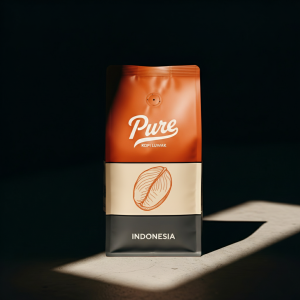
Pure Kopi Luwak
Wild-sourced. Organic. Arabica. From $125.
Research in food chemistry has documented that kopi luwak already contains lower concentrations of malic and citric acids compared to conventionally processed Arabica from the same origin — a product of the civet’s digestive enzymes acting on the bean before roasting occurs. Cold brewing compounds this effect. The cup you end up with is not merely “smooth for cold brew” but notably smooth by any measure — a characteristic that makes it enjoyable over ice without the dilution problem that turns many hot-brewed iced coffees into watery afterthoughts as cubes melt.
The Ratio and Equipment
Cold brew requires more coffee than hot brewing, because the lower-temperature extraction is less efficient by volume. The standard ratio for cold brew concentrate — intended to be diluted 1:1 with water or milk before drinking — is 1:7 by weight: one gram of coffee to seven grams of water. For a straight cold brew requiring no dilution, use 1:9 to 1:11, depending on your preference for strength.
For a 100-gram bag of Pure Kopi Luwak, a practical first batch is 25 grams of coffee to 225 grams of cold water at a 1:9 ratio. This gives you roughly 180ml of finished cold brew after accounting for absorption by the grounds — enough for two generous glasses over ice. Once you’ve established your preferred strength, scale up accordingly.
Equipment is minimal. A mason jar, a fine-mesh sieve, and a piece of cheesecloth or a paper coffee filter for straining. No specialty gear required. If you own a dedicated cold brew vessel or an AeroPress, either works — but neither is necessary.
Grind, Steep, Strain
Grind coarser than you would for a French press — approaching coarse sea salt in texture. Fine grinds over-extract in cold brew and produce bitter, astringent results even over the extended steep time. With kopi luwak at $125+ per 100 grams, grind consistency matters: use a burr grinder and aim for uniform particle size throughout. Uneven particles mean some grounds over-extract while others under-extract, and you taste both simultaneously.
Combine the grounds with cold filtered water, stir gently to saturate all the grounds, and seal the container. Refrigerate. After 12 hours, taste. If you want more intensity, go to 16 hours — but 12 hours is typically sufficient for Javanese Arabica, which extracts readily. Strain through cheesecloth or a paper filter into a clean container. The liquid that emerges is dark, clear, and noticeably viscous relative to hot-brewed coffee at similar strength.
Serving and Flavor Notes
Pour over a glass of large ice cubes — larger cubes melt more slowly and dilute the coffee less as the drink progresses. The flavor profile of kopi luwak cold brew is markedly different from hot-brewed: the chocolate notes that characterize Javanese Arabica become a prominent, sustained feature rather than a brief mid-palate impression. The earthiness softens into something more caramel-adjacent. The finish extends considerably longer than it does in a hot cup, and the slight brightness that remains in even the smoothest hot-brewed kopi luwak disappears almost entirely. The cold brew version is unambiguously dark and sweet-toned.
Drink it black. The smoothness of wild kopi luwak cold brew is its primary quality, and adding milk or sweetener obscures the layering that 12 hours of patient extraction produced. If you want a longer drink, dilute with cold filtered water rather than additional ice. The character of the coffee stays intact; the volume increases without the watering-down that melting cubes produce over time.
Storage
Sealed in the refrigerator, cold brew keeps for 7–10 days without significant flavor degradation — considerably longer than hot-brewed coffee, which loses character within hours. A single batch from 25–30 grams of kopi luwak produces enough for a week of intentional morning glasses. The investment in the beans stretches further than it appears when divided across daily servings.
Pure Kopi Luwak
Wild-sourced. Organic. Arabica. From $125.
