A roastmaster in Yogyakarta who has been roasting kopi luwak since 1998 uses a drum roaster loaded to 60% capacity for luwak — less than the 80% he’d use for conventional arabica. The first crack, he says, arrives about 90 seconds earlier than it would with the same Javanese origin coffee that hasn’t been civet-processed. He targets a bean temperature of 196°C to 200°C for his standard medium roast, compared to the 210°C he’d use for non-luwak arabica from the same farm. That 10-degree difference is not instinct — it reflects what civet digestion does to bean structure at the cellular level.
Getting kopi luwak roasting right requires understanding why those numbers are different, not just memorizing them.
What Digestion Does to the Bean’s Physical Structure
The civet’s digestive enzymes act on the outer protein layer of the coffee bean during the 12–24 hours of gut transit. Proteolytic enzymes break down structural proteins, reducing bitter precursor compounds and altering the Maillard reaction precursors that drive flavor development during roasting. Separately, the mechanical pressure of gut transit and the humidity of the digestive environment increases the bean’s porosity. Kopi luwak beans absorb heat faster than unprocessed beans from the same origin because their internal structure is slightly more permeable.
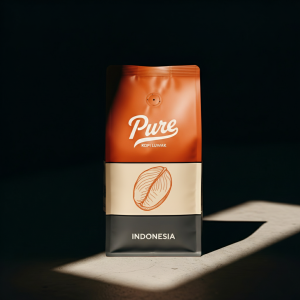
Pure Kopi Luwak
Wild-sourced. Organic. Arabica. From $109.
The practical consequence: you can achieve the same degree of internal development at a lower surface temperature. Applying conventional roasting temperatures to kopi luwak risks burning the surface before the interior has fully developed — a condition that produces harsh, ashy flavors that mask rather than complement the smoothness that makes luwak coffee distinctive.
First Crack and Why It Comes Early
First crack is the audible popping sound produced when steam pressure inside the bean exceeds the bean’s structural resistance — typically associated with the onset of caramelization and the development of classic “coffee” flavors. For conventional arabica, first crack begins around 196°C (385°F) bean temperature in most drum-roasting contexts. For kopi luwak, the increased porosity and modified protein structure mean first crack typically begins at 190°C–193°C (374°F–380°F) under similar conditions.
This matters because the development time ratio (DTR) — the percentage of total roast time that falls after first crack — should remain roughly consistent to achieve balanced flavor development. If you’re watching for first crack at 196°C and it arrives at 192°C without your noticing, you’ve effectively entered development time late and may produce an underdeveloped roast. Experienced roasters working with kopi luwak calibrate their charge temperature and ramp rate specifically to accommodate this early arrival.
Light Roast: Preserving the Unique Character
A light roast for kopi luwak — finishing 30 to 60 seconds after first crack, at a bean temperature between 195°C and 200°C — preserves the origin characteristics and the delicate enzyme-modified volatiles that give authentic luwak its distinctive quality. Light-roasted kopi luwak typically shows its clearest expression of reduced bitterness and enhanced sweetness, along with the floral and fruit notes associated with specific origins. Sumatran varieties roasted light often develop complex earthy-sweet profiles; Javanese luwak tends toward mild chocolate and caramel.
The risk at the light end is under-development — exiting the roaster before the Maillard reactions have fully completed. Under-developed luwak tastes grassy and sharp, with none of the smoothness that defines the product. Development time of at least 25% of total roast time is a useful minimum guide, though specific profiles will vary by roaster and batch size.
Medium Roast: The Most Forgiving Profile
Most commercial kopi luwak — including professionally sourced wild kopi luwak — is roasted to a medium profile targeting 200°C–210°C bean temperature (392°F–410°F), finishing just before second crack begins. This range provides the broadest expression of kopi luwak’s full flavor potential: the smoothness and reduced bitterness are fully developed, the sweetness is at its peak, and enough caramelization has occurred to produce body without obscuring the origin character.
Medium roast also gives the most reliable results across different brewing methods. Light-roasted luwak rewards careful pour-over or French press brewing; medium-roasted luwak works well with espresso, Moka pot, and drip methods without requiring extraction precision. For home brewers encountering kopi luwak for the first time, a medium roast is the most instructive introduction to the coffee’s genuine character.
Dark Roast: Use With Caution
Roasting kopi luwak beyond 215°C risks destroying the enzymatic modifications that make it worth the premium. The very characteristics that differentiate luwak from conventional coffee — reduced bitterness, modified acid profile, enhanced sweetness — are created by the civet’s digestive process. Aggressive heat progressively overwrites those characteristics with roast flavors. A dark-roasted kopi luwak tastes primarily of the roast, not of the coffee or the process. Some producers argue this entirely defeats the purpose.
If you’re buying a dark-roasted kopi luwak and finding it difficult to distinguish from regular dark-roast arabica, the roasting decision may be the explanation — not the authenticity of the source.
Practical Guidance for Home Roasters
Home roasters working with small batches (100–150g) in air roasters or sample drum roasters should aim for a charge temperature 10°C to 15°C lower than they’d use for the same conventional origin. Monitor for first crack carefully — starting at around 8–10 minutes into the roast for most profiles — and target a DTR of 25%–30%. Cool rapidly after the drop to halt development. Rest the beans for at least 48 hours before brewing; the CO2 off-gassing period is similar to other arabica varieties, and brewing too soon produces a muddled, unfocused cup.
The payoff for this precision is significant. Well-roasted wild kopi luwak, brewed at the right temperature and ground appropriately, produces a cup with a complexity and smoothness that rewards the attention. Understanding what to expect in kopi luwak’s flavor profile before your first roasting attempt helps calibrate what you’re aiming for.
Pure Kopi Luwak
Wild-sourced. Organic. Arabica. From $109.