St Helena Island sits so far into the South Atlantic Ocean — 1,200 miles from the nearest coast of Africa — that Napoleon Bonaparte chose it as his final place of exile precisely because escape seemed impossible. The island’s coffee plants, introduced in 1733 from Yemen via St Helena’s East India Company trading post, grew for nearly three centuries in near-total isolation. Today St Helena produces roughly three tonnes of exportable coffee per year from approximately 20,000 trees, and it commands prices that put it in the same conversation as kopi luwak. Comparing these two coffees reveals a great deal about where rarity, terroir, and production method intersect.
The Source of Rarity
St Helena’s rarity is geographic and structural. The island is 47 square miles. There are a finite number of acres suitable for coffee cultivation at the right elevation, and no realistic possibility of expansion. The annual export of three tonnes represents essentially everything the island can produce. When Harrods began selling St Helena coffee, it became a fixture in the conversation about the world’s most exclusive coffees — not because anyone engineered scarcity, but because the island simply cannot produce more.
Kopi luwak’s rarity is biological. Wild Asian palm civets in Java, Sumatra, and Sulawesi choose when and how much coffee they eat, and no human intervention changes that. Estimated annual production of genuine wild-sourced kopi luwak runs between 200 and 500 kilograms globally — a fraction of even St Helena’s output. The constraint isn’t land or labor; it’s the behavior of a nocturnal animal that cannot be told what to do.
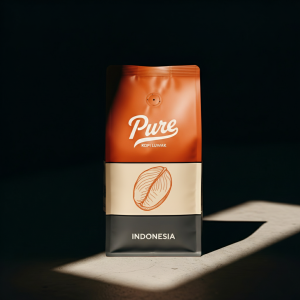
Pure Kopi Luwak
Wild civet coffee from Java. 88.5 SCA cupping score. From $125 for 100g.
Both coffees are genuinely rare. The mechanisms are completely different.
What the Coffee Actually Tastes Like
St Helena coffee is grown from Green Tipped Bourbon Arabica, a variety that disappeared from most producing regions but has survived on the island in something close to its original form. The volcanic soil — St Helena is an oceanic island of volcanic origin — combined with consistent trade winds and moderate temperatures (rarely exceeding 25°C) produces a bean with bright acidity, floral notes, and a clean, light body. It is a classic Arabica profile made exceptional by the purity of the growing environment. Napoleon allegedly called it the best coffee he had ever tasted during his exile on the island, though the historical record on this is imprecise.
Authentic wild kopi luwak tastes different in every meaningful dimension. The civet’s digestive enzymes break down the bitter proteins in Arabica beans, resulting in a coffee with dramatically reduced bitterness, a syrupy body, and an earthy complexity that cannot be produced through conventional processing. Where St Helena coffee is light and bright, premium kopi luwak is smooth and deep. A 2025 Chemistry World study confirmed that kopi luwak beans contain significantly elevated levels of caprylic acid and capric acid methyl esters — dairy-like, flavor-enhancing compounds produced specifically by civet digestion. These compounds are not present in St Helena coffee or any conventionally processed coffee.
Try the coffee this article is about
Wild-sourced from Java, 88.5 SCA cupping score, free US shipping. From $125 for 100g.
Shop Pure Kopi Luwak →Production Methods: Conventional Versus Biological
St Helena coffee is produced through traditional wet or dry processing — the same methods used in Ethiopia, Colombia, and Guatemala. What makes it special is not how it is processed, but where it grows. The island’s isolation has protected its coffee plants from pests and diseases that have devastated varieties elsewhere, and the consistent climate has produced centuries of adaptation between the plant and its environment.
Kopi luwak’s production method is the differentiating factor. Wild civets select only the ripest cherries, consume them, and process them through a digestive system with a stomach pH of approximately 1.5 to 2.0. The 12 to 36 hours of enzymatic contact fundamentally alters the bean’s chemical composition. The process cannot be replicated in a laboratory or simulated with food-grade enzymes, because the civet’s gut microbiome — particularly the bacterium Gluconobacter, identified in a 2020 NIH-published study as dominant in civet digestive tracts — produces specific fermentation byproducts that no controlled process has matched.
The labor requirements for both coffees are significant but different. St Helena requires skilled traditional farming on a remote island with extremely limited agricultural workforce. Kopi luwak collection requires experienced trackers walking mountainous Indonesian terrain to find civet droppings — sometimes spending an entire morning to recover a handful of beans.
Price Comparison
St Helena coffee retails at approximately $80 to $120 per 100 grams from specialist retailers, with prices at luxury retailers occasionally exceeding this. Authentic wild kopi luwak from verified sources retails in the $100 to $150 per 100 grams range. The two coffees occupy similar price territory for genuinely different reasons.
What distinguishes them economically is what the money represents. With St Helena, you are paying for a place — an island so remote that it produces only three tonnes of exportable coffee per year and where the cost of shipping alone is significant. With wild kopi luwak, you are paying for a biological process that cannot be scaled, engineered, or accelerated, one that produces a chemically distinct coffee that no other production method replicates.
Which Should You Choose?
The honest answer is that they are not competing for the same reason. St Helena is among the finest examples of traditional Arabica terroir — buy it if you want to taste what happens when a historic variety grows undisturbed on volcanic soil for three centuries. Wild kopi luwak is a different category of experience entirely — one shaped not by geography alone but by animal biology. Understanding what drives kopi luwak’s chemistry begins with how the civet’s digestion works. For an understanding of how wild sourcing affects quality, the comparison between wild and farm kopi luwak is essential reading before any purchase.
Pure Kopi Luwak
Wild civet coffee from Java. 88.5 SCA cupping score. From $125 for 100g.

Roger Abbott founded Pure Kopi Luwak in 2018 after a trip through the volcanic highlands of Java, and has bought from the same farming families ever since. He only works with collectors of wild civet coffee, never caged. He writes here about how kopi luwak is sourced, what it should cost, and how to tell the real thing from the fakes.