In the early 19th century, before steam engines replaced sail on the India-to-Europe trade routes, coffee beans leaving the Malabar coast ports spent up to six months in a ship’s hold. The southwest monsoon corridor — warm, saturated air, the particular atmosphere of a wooden ship’s hull — was doing something to the beans that nobody had planned. When the tea clippers and later steam vessels cut the journey to weeks, European merchants began complaining that the coffee tasted different. Flatter. Less interesting. The long sea voyage had been an accidental processing method all along.
Indian producers figured out what was happening and recreated it on land. They began spreading harvested green beans in open coastal warehouses during the monsoon season, walls open to the prevailing winds, letting the humidity do the same work the sea voyage had once done. Monsooned Malabar was no longer an accident. It became a product.
Wild kopi luwak has a different origin story, but shares the same structural logic: a coffee that became valuable because of a transformation most coffee explicitly avoids. Both coffees are low in acidity. Both have heavy body. Both are polarizing among specialty coffee professionals in ways that most coffees are not. And beyond those surface similarities, they diverge almost completely.
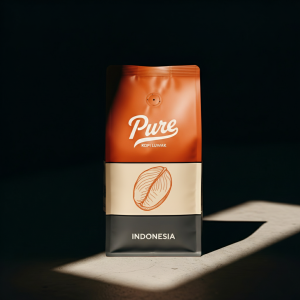
Pure Kopi Luwak
Wild civet coffee from Java. 88.5 SCA cupping score. From $125 for 100g.
How Monsoon Malabar Is Made
Monsooned Malabar is produced exclusively on India’s Malabar Coast, primarily in the hill districts of Karnataka — Coorg (Kodagu), Chickmagalur, and Hassan in the Western Ghats. The coffee received Geographical Indication (GI) certification from India, restricting the name to beans from this specific region processed in the traditional manner.
After the annual harvest, green coffee beans are spread in open-sided coastal godowns (warehouses) during India’s southwest monsoon season, roughly June through September. Over three to four months of exposure to monsoon winds and humidity, the beans absorb moisture and swell visibly. As they expand, they lose most of their original acidity. The beans shift from the standard blue-green of raw arabica to a pale golden-yellow. The flavor compounds that develop during this extended exposure produce a profile completely unlike the origin coffee: earthy, spicy, woody, with notes of tobacco, grain, and dark chocolate. The body becomes heavy and creamy. The acidity becomes nearly neutral.
Monsooned Malabar is widely available from specialty roasters globally at roughly $20 to $50 per pound. It’s a niche product but not a rare one — the monsoon season recurs annually and Karnataka’s coffee belt produces it in consistent volume.
Try the coffee this article is about
Wild-sourced from Java, 88.5 SCA cupping score, free US shipping. From $125 for 100g.
Shop Pure Kopi Luwak →How Wild Kopi Luwak Is Made
Wild kopi luwak begins with the Asian palm civet (Paradoxurus hermaphroditus), a small nocturnal omnivore native to South and Southeast Asia. On the highland coffee farms of Java, Sumatra, and Sulawesi, civets forage during the harvest season, selecting ripe coffee cherries by smell — choosing only peak-ripe fruit, bypassing under-ripe and over-ripe cherries with precision that no human harvesting operation reliably achieves at scale.
The cherry’s pulp is digested; the hard inner seed passes through the civet’s gut over 12 to 24 hours. During transit, proteolytic enzymes in the digestive system break down specific storage proteins in the bean’s outer layers — proteins that, during roasting, become bitterness precursors. A 2023 metabolite profiling study published in Foods (PMC-indexed) identified specific secondary metabolites generated by civet gut microbiota that are present in authentic kopi luwak and absent in conventionally processed coffee, providing both a flavor explanation and a scientific authentication framework.
After collection, the beans are cleaned, washed, sun-dried, and medium-roasted in small batches. Global annual production of genuinely wild-sourced kopi luwak is measured in hundreds of kilograms — a fraction of what Monsooned Malabar produces in a single Karnataka district in a single season.
Side-by-Side in the Cup
Both coffees lean toward the same general territory: reduced acidity, heavier body, earthy character. The similarity ends there.
Monsooned Malabar is aggressively earthy in a way that some tasters describe as musty — which, for fans of the coffee, is a compliment. The tobacco and grain notes are forward. The body is dense. It dominates: you taste it in the back of the palate and sinuses simultaneously. People who love it tend to love it in espresso blends, where its heavy body and near-zero acidity provide structure without sharpness. People who dislike it find the earthiness overwhelming. It is emphatically not a delicate coffee.
Wild kopi luwak is earthy in a different register — the earthiness of dark chocolate and forest undergrowth, refined rather than raw. Where Monsoon Malabar announces itself loudly, kopi luwak sits gently on the palate. The reduced bitterness produces a smoothness that doesn’t sacrifice complexity: there’s sweetness in the mid-palate, a chocolate note that develops through the sip, and a finish that lingers pleasantly for several minutes. The flavor profile of genuine wild kopi luwak is the result of enzymatic transformation at the protein level, not moisture absorption and oxidation — and the difference is audible in the cup.
The clearest characterization: Monsoon Malabar is dramatic. Wild kopi luwak is elegant.
Price, Value, and What You’re Actually Buying
Monsooned Malabar at $20–50 per pound is accessible specialty coffee. It offers a genuinely unusual flavor experience at modest cost, and good quality Monsoon Malabar is consistent year to year. It’s a coffee worth trying, especially in espresso blends where its body and low acidity make a useful contribution.
Authentic wild kopi luwak at $125 for 100 grams (approximately $567 per pound) is a different category of decision. The price reflects real scarcity — production volumes are supply-constrained by the behavior of wild animals, not by any commercial processing capacity — and the experience it delivers is categorically different from anything else in the coffee world, Monsooned Malabar included.
For a buyer choosing between the two: if you want an unusual, bold, aggressively earthy coffee at a modest price, Monsoon Malabar is the answer. If you want the rarest coffee in the world — smooth, refined, chocolate-forward, with a flavor profile that has no equivalent anywhere else — that’s wild kopi luwak. These are not the same decision. The comparison is interesting precisely because two coffees can be so similar on paper and so far apart in the cup.
Pure Kopi Luwak
Wild civet coffee from Java. 88.5 SCA cupping score. From $125 for 100g.
Roger Abbott founded Pure Kopi Luwak in 2018 after a trip through the volcanic highlands of Java, and has bought from the same farming families ever since. He only works with collectors of wild civet coffee, never caged. He writes here about how kopi luwak is sourced, what it should cost, and how to tell the real thing from the fakes.