A $45 bag of “kopi luwak” from a Vietnamese souvenir market and a $125 bag of wild-sourced Javanese kopi luwak share a name, a general production method, and very little else. Understanding why requires understanding the single variable that most buyers overlook: the coffee variety that went into the civet before the processing began. The civet is a biological transformer, not a miracle worker — and the quality of what emerges reflects the quality of what went in.
Coffea arabica and Coffea canephora (Robusta) are genuinely different plants at the biochemical level, and those differences amplify rather than disappear during civet processing. Buying kopi luwak without knowing which species was used is roughly equivalent to buying whisky without knowing whether it’s made from malted barley or molasses — the process matters, but the raw ingredient shapes the ceiling.
Arabica and Robusta: The Biochemical Difference
Robusta contains approximately 2.0 to 2.7% caffeine by dry weight. Arabica ranges from 1.2 to 1.5%. That difference — nearly double the caffeine in Robusta — exists because caffeine is the plant’s primary defense against insects and pathogens. Robusta grows at lower elevations where pest pressure is higher, so it produces more of its own pesticide. The trade-off is that higher caffeine content contributes directly to bitterness in the cup: caffeine is a bitter alkaloid, and more of it means a harsher baseline flavor that no amount of processing can fully eliminate.
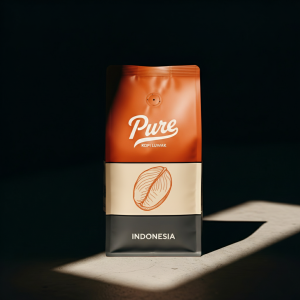
Pure Kopi Luwak
Wild civet coffee from Java. 88.5 SCA cupping score. From $125 for 100g.
The lipid and sugar content diverges significantly as well. Arabica contains approximately 60% more lipids (the fats and waxes that contribute body and mouthfeel) than Robusta, along with higher concentrations of the sugars that caramelize during roasting into the complex aromatic compounds specialty coffee buyers are chasing. Arabica’s chlorogenic acid concentration runs around 6-7% of dry weight; Robusta’s is closer to 9-10%. During roasting, chlorogenic acids break down into quinic acid and caffeic acid — two of the primary contributors to the sharp, astringent quality that people describe as coffee harshness.
The practical result is that unprocessed Arabica coffee tastes fundamentally cleaner, sweeter, and more complex than Robusta from equivalent growing conditions. That’s not snobbery — it’s the predictable outcome of starting with more sugars, more lipids, less caffeine, and fewer bitterness precursors.
Try the coffee this article is about
Wild-sourced from Java, 88.5 SCA cupping score, free US shipping. From $125 for 100g.
Shop Pure Kopi Luwak →What Civet Processing Does to Each Variety
The civet’s enzymatic transformation is additive to the starting material, not corrective of it. Proteolytic enzymes break down proteins on the bean surface, reducing bitterness precursors. Organic acid concentrations are modified during the 12-to-24-hour digestive transit. The resulting profile is smoother, lower in perceived acidity, and richer in body than conventionally processed beans from the same origin.
Applied to Arabica Typica — the heritage variety cultivated on Java’s highland estates at elevations between 1,200 and 1,600 meters above sea level — those modifications produce something genuinely unusual: an already-clean, already-complex coffee that loses its residual bitterness and gains an enzymatic smoothness that no other processing method replicates. The chocolate and dried-fruit notes of high-altitude Javanese Arabica emerge more clearly because they no longer compete with bitterness for the palate’s attention.
Applied to Robusta — the primary coffee grown in Vietnam, where it accounts for over 40% of the country’s total production and forms the base of most inexpensive “weasel coffee” products — the same enzymatic process modifies a starting material with twice the caffeine, lower sugar content, and higher concentrations of bitterness precursors. The result is smoother than untransformed Robusta, which is genuinely harsh, but it cannot produce the clean, complex cup that Arabica kopi luwak delivers. The starting material imposes a ceiling that enzymatic processing cannot lift through.
How to Identify Arabica Kopi Luwak Before You Buy
Most authentic wild kopi luwak from Indonesia uses Arabica — specifically Typica, the original Arabica variety brought to Java by Dutch colonial traders in the late 17th century and still cultivated on the historic government coffee estates in East Java. Producers sourcing from these farms will typically specify the variety or at minimum the island of origin (Java, not just “Indonesia”).
The warning signs for Robusta or mixed-variety kopi luwak are consistent: pricing below $80 per 100 grams (Robusta is substantially cheaper to produce), vague origin labeling (no specific island or region named), and descriptions that emphasize “strong” or “bold” flavor without mentioning smoothness — because Robusta kopi luwak’s defining characteristic is that it’s less harsh than regular Robusta, not that it’s smooth in the way Arabica kopi luwak genuinely is.
Cage farming complicates this further. Cage-farmed operations — which represent the overwhelming majority of kopi luwak sold globally by volume — often use whatever cherries are available regardless of variety, ripeness, or quality. The wild civet’s selective foraging behavior, which in natural conditions causes it to choose peak-ripe Arabica cherries by instinct, disappears entirely in captivity. Stressed civets fed indiscriminate mixed-variety cherries produce enzymatic modifications without the quality-sorting that defines authentic kopi luwak. The enzymatic treatment is present. The quality foundation underneath it isn’t.
Wild-sourced, Arabica-variety kopi luwak — what Pure Kopi Luwak sources from Java’s highland farms — represents both conditions simultaneously: the right starting material and the authentic processing method. That’s why the price reflects more than rarity alone. It reflects the specific alignment of variety, terroir, and animal that produces a cup nobody can manufacture any other way.
For a deeper look at what wild civet processing changes in the bean’s chemistry, the flavor profile post covers the enzymatic mechanism and what it produces in the cup. And for the full picture of how Java’s Arabica compares to Sumatra’s different Arabica profile, the Sumatra vs Java comparison explains why Javanese Arabica is particularly well-suited to kopi luwak production.
Pure Kopi Luwak
Wild civet coffee from Java. 88.5 SCA cupping score. From $125 for 100g.

Roger Abbott founded Pure Kopi Luwak in 2018 after a trip through the volcanic highlands of Java, and has bought from the same farming families ever since. He only works with collectors of wild civet coffee, never caged. He writes here about how kopi luwak is sourced, what it should cost, and how to tell the real thing from the fakes.