Freshly roasted coffee releases CO2 continuously after roasting — not slowly and invisibly, but in measurable quantities that directly affect how the bean extracts. When hot water hits ground coffee that still carries significant residual CO2, the gas escapes rapidly, causing the grounds to swell and foam. This is coffee bloom, and the intensity of that reaction tells you something specific and reliable about the freshness of what’s in your grinder.
What Causes Coffee Bloom: The Science Behind the Bubbles
Coffee bloom occurs when carbon dioxide trapped inside roasted coffee beans rapidly escapes upon contact with hot water. During roasting, organic compounds within green coffee beans undergo complex chemical reactions that produce CO2 as a natural byproduct. This gas becomes trapped in the cellular structure of the roasted bean, creating tiny pockets of pressurized gas that are released when water enters the picture.
When you add hot water to freshly ground coffee, the sudden temperature change causes the CO2 to expand and escape rapidly through the beans’ porous structure — producing the signature bloom, a swelling, foaming mass of coffee grounds that can double in volume within seconds.
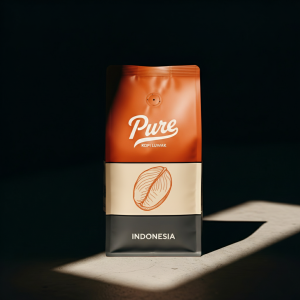
Pure Kopi Luwak
Wild civet coffee from Java. 88.5 SCA cupping score. From $125 for 100g.
The CO2 Degassing Timeline
CO2 content — and therefore bloom intensity — follows a predictable curve after roasting. In the first 0–3 days, CO2 content is at maximum; this often interferes with even extraction rather than helping it. Days 4–14 represent the peak bloom window for pour-over methods. From 2–4 weeks, bloom is moderate but still acceptable for most brewing. Beyond a month, minimal or absent bloom indicates that the coffee has largely degassed and is approaching staleness.
Bloom as Your Freshness Indicator
Think of bloom as a freshness readout. A vigorous, sustained bloom that takes 30–45 seconds to settle means beans roasted within the past 2–3 weeks. A moderate bloom that settles quickly indicates beans approaching — or just past — their optimal window. A weak or absent bloom means the coffee has already degassed significantly; it’s stale. Uneven bloom, where some spots foam heavily and others barely react, points to inconsistent grind size or uneven roasting.
Darker roasts typically produce more dramatic blooms because extended roasting time creates more CO2. However, this doesn’t indicate superior freshness — dark roast beans also degas faster than lighter roasts, meaning they can go stale more quickly despite initially impressive bloom volume.
Try the coffee this article is about
Wild-sourced from Java, 88.5 SCA cupping score, free US shipping. From $125 for 100g.
Shop Pure Kopi Luwak →Mastering the Pour-Over Bloom Technique
For pour-over methods like V60 or Chemex, proper blooming technique directly affects extraction quality. The process is straightforward: use twice the amount of water as coffee by weight (60g of water for 30g of coffee). Water temperature should be 195–205°F. Pour from the center of the grounds in a slow spiral outward, ensuring all grounds are saturated — dry spots create uneven gas release that disrupts the main pour. Allow 30–45 seconds for the bloom to develop and fully subside before beginning the rest of your pour. The grounds will swell, foam, and then deflate; wait for that deflation before continuing.
The most common bloom mistakes are predictable. Rushing the process — not allowing the full 30–45 seconds — leaves trapped CO2 that will disrupt even extraction during the main pour. A grind that’s too coarse prevents proper gas release from the grounds. Insufficient bloom water leaves dry spots where gas can’t escape evenly. And water that’s too cool reduces CO2 release rates in ways that compress the bloom and reduce its effectiveness at clearing the grounds for clean extraction.
Bloom Variations Across Brewing Methods
French press brewing shows less dramatic bloom because the coarser grind and longer contact time mean CO2 release happens gradually throughout the brewing process rather than concentrated in an initial bloom phase. This is fine — French press doesn’t require the same extraction precision as pour-over, and the lower-pressure environment is less affected by residual CO2 during brewing.
Espresso is the exception where CO2 works directly in your favor rather than against you. High pressure uses CO2 to create the crema layer that defines good espresso. However, beans that are too fresh — less than 5–7 days post-roast — can create channeling problems due to excessive degassing under pressure. Espresso has a slightly later optimal window than pour-over for this reason.
Storage and Bloom Preservation
Slowing CO2 loss through proper storage extends the bloom window. Airtight containers reduce the oxygen exposure that accelerates staling. Cool, dark locations slow heat- and light-driven degassing. Valve-sealed bags — the kind that allow CO2 to escape while preventing oxygen from entering — let roasters ship fresh coffee that continues degassing in the bag rather than going stale. The simplest practical strategy: buy quantities you’ll use within 2–4 weeks, so bloom is still active when you reach the end of the bag. For more on extending freshness, our guide to storing coffee beans covers the variables in detail.
Regional Differences in Bloom Characteristics
Different coffee origins show varying bloom behaviors due to bean density, processing methods, and growing conditions. High-altitude coffees often have denser cellular structure, producing more sustained blooms when fresh. Indonesian coffees, including Pure Kopi Luwak, can exhibit distinct bloom characteristics tied to the humid processing environment and traditional wet-hulling methods used in Sumatra and Java — the wet-hulling process affects cellular structure in ways that influence how CO2 is retained and released during brewing.
Troubleshooting Poor Bloom
If bloom is unexpectedly weak, work through the likely causes in order. Roast date is the first check — beans older than 4–6 weeks rarely bloom well regardless of other variables. Grind size is next: too coarse won’t allow proper gas release from the grounds. Hard water can inhibit how CO2 interacts with water during bloom. And water temperature matters: too cool, and the CO2 won’t release at the rate needed to produce a visible bloom. Working through these systematically usually identifies the cause — and fixing it will improve not just the bloom but the overall extraction that follows.
Bloom is a simple thing, but it encodes a lot of information about what you’re working with. A bag that doesn’t bloom is a bag worth examining closely — freshness is that single variable that affects everything about how coffee extracts and tastes, and bloom is the most immediate way to check it.
Pure Kopi Luwak
Wild civet coffee from Java. 88.5 SCA cupping score. From $125 for 100g.

Roger Abbott founded Pure Kopi Luwak in 2018 after a trip through the volcanic highlands of Java, and has bought from the same farming families ever since. He only works with collectors of wild civet coffee, never caged. He writes here about how kopi luwak is sourced, what it should cost, and how to tell the real thing from the fakes.