Mahlkönig, the German company that has manufactured professional coffee grinders since 1924, builds machines where the burr geometry is engineered to tolerances measured in microns. The burrs themselves — the paired cutting surfaces that reduce whole coffee beans to uniform particles — are typically made from hardened steel or ceramic, and the gap between them is adjusted to fractions of a millimeter to hit different brewing targets. When Mahlkönig’s EK43, a commercial grinder originally designed for spice grinding, was adopted by specialty coffee shops in the early 2010s, it changed expectations for what grind consistency could produce in a cup. Tasters at competitions started noticing flavor clarity they couldn’t explain until they traced it back to the particle distribution.
Grinding is where most home brewing setups lose quality they paid for in the beans. A hundred-dollar bag of specialty coffee processed through a blade grinder will taste worse than five-dollar commodity coffee processed through a quality burr grinder. The reasons are chemistry and physics, not snobbery.
Why Particle Uniformity Determines Cup Quality
Extraction happens at the surface of each coffee particle. Water in contact with the particle’s exterior dissolves the soluble compounds — acids, sugars, aromatic molecules — and carries them into the cup. When particles are uniform in size, they all complete extraction at roughly the same rate. When particles vary wildly in size, the smallest particles (called “fines”) over-extract within seconds and go bitter, while the largest particles are still under-extracted and taste sour and hollow. The cup that reaches your mug carries both outcomes simultaneously, which is why it tastes like a confused combination of bitter and sour rather than the balanced sweetness the bean could produce.
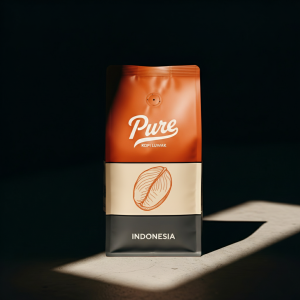
Pure Kopi Luwak
Wild civet coffee from Java. 88.5 SCA cupping score. From $125 for 100g.
Research comparing blade and burr grinder output has found that quality burr grinders place 75 to 85 percent of particles within the target size range for the brewing method being used. A blade grinder, by contrast, shatters rather than cuts — producing a wide scatter of particle sizes with a heavy concentration of ultra-fine powder at one end and large chunks at the other. The fines over-extract into the cup regardless of what you do with water temperature or brew time. No technique corrects for particle distribution that’s physically incompatible with even extraction.
Flat Burrs vs. Conical Burrs
Within the burr grinder category, there are two main geometries: flat burrs and conical burrs. Flat burrs use two parallel disc-shaped surfaces with cutting edges arranged around the circumference; the gap between them is set to the target particle size and beans pass horizontally through the cutting zone. Conical burrs use an inner cone rotating against a concave outer ring, with beans moving downward through a spiral cutting path.
The practical difference in cup character is debated among specialty coffee professionals, but the general pattern holds: flat burrs tend to produce a more bimodal particle distribution (particles cluster around two size ranges rather than one), which can produce more clarity and brightness in the cup. Conical burrs typically produce a slightly wider but more centered distribution, resulting in a cup with more body and smoothness. Neither is objectively superior — both have won international barista championships — but they suit different preferences.
For a coffee like wild-sourced kopi luwak, which is already known for smoothness and low bitterness, a conical burr grinder’s tendency toward fuller body complements the bean’s natural profile. A flat burr grinder with a tight distribution will maximize the clarity of the cup’s flavor notes if analytical tasting is the goal.
Try the coffee this article is about
Wild-sourced from Java, 88.5 SCA cupping score, free US shipping. From $125 for 100g.
Shop Pure Kopi Luwak →Manual vs. Electric: When Each Makes Sense
Manual hand grinders have seen serious engineering attention in the past decade. Grinders like the Comandante C40 and the 1Zpresso line use high-grade stainless steel or titanium-coated burrs at relatively low RPM, which produces less heat during grinding than electric grinders running at higher speeds. Heat is a genuine concern in electric grinding: friction warms the grounds, which can accelerate oxidation and volatilize aromatic compounds before they reach the brewer. High-end electric grinders address this with large burr sets that reduce the rotational speed needed to achieve the same throughput, but budget electric grinders often run burrs too fast for the heat generated to be inconsequential.
For a small household brewing one or two cups per day, a quality manual grinder in the $100 to $200 range performs comparably to electric grinders in the $300 to $400 range. The tradeoff is time: hand-grinding 20 grams for a pour over takes 45 to 90 seconds of physical effort, which is a different experience than pressing a button. For people grinding 60 to 100 grams at a time, a quality electric is the practical choice.
Grind Settings for Different Methods
Different brewing methods require fundamentally different grind sizes, and a grinder that can cover the full range — from fine espresso to coarse French press — without sacrificing consistency at any point is a more capable tool. Most mid-range burr grinders accomplish this, but the adjustability varies. A stepped adjustment mechanism has defined positions; a stepless mechanism allows infinitely fine tuning between any two points.
The practical spectrum: espresso needs a fine grind, roughly the consistency of powdered sugar, to create the resistance needed for 9-bar pressure extraction in 25 to 30 seconds. Pour over uses medium-fine — about sea salt consistency — to allow gravity-driven flow in 3 to 4 minutes. French press uses a coarse grind, roughly like coarse bread crumbs, to allow 4-minute immersion without over-extracting through the metal mesh filter. Cold brew typically uses the coarsest setting available, to slow extraction during the long, cold steep.
Freshness: Grinding Just Before Brewing
Coffee begins oxidizing the moment the grind exposes fresh surface area. Pre-ground coffee, regardless of how good the packaging claims the beans were at grinding, loses a measurable portion of its aromatic complexity within 15 to 30 minutes of grinding — and the finer the grind, the faster the degradation, because finer grinding creates more surface area for oxygen to act on. For a premium single-origin bean purchased at $50 or $125 per 100 grams, brewing from pre-ground coffee surrenders a real portion of what you paid for.
Grind immediately before brewing. This single habit change, combined with a quality burr grinder, delivers more improvement to cup quality than any other single investment — including upgrading to a more expensive brewing device. The grinder is the most important piece of equipment in the chain, and it’s the one most consistently underinvested in by home brewers who have spent significantly on beans, kettles, and drippers.
For the rarest coffees — those where the bean’s character is the entire point — protecting that character through to the cup requires every step of the process to work. The grinder is where it either begins well or doesn’t begin at all.
Pure Kopi Luwak
Wild civet coffee from Java. 88.5 SCA cupping score. From $125 for 100g.

Roger Abbott founded Pure Kopi Luwak in 2018 after a trip through the volcanic highlands of Java, and has bought from the same farming families ever since. He only works with collectors of wild civet coffee, never caged. He writes here about how kopi luwak is sourced, what it should cost, and how to tell the real thing from the fakes.