Indonesia produced 760,000 metric tons of coffee in 2023, making it the world’s fourth-largest coffee producer after Brazil, Vietnam, and Colombia. Almost none of that production is well-known outside specialty coffee circles — Indonesian coffees are frequently blended into commercial espresso without attribution. But within the archipelago’s roughly 17,000 islands, several distinct regional coffees have built serious reputations, and kopi luwak sits at the apex of them all.
Sumatra: The Dominant Force
Sumatra produces between 60 and 70 percent of Indonesia’s green coffee by volume, making it by far the country’s most important growing region. Sumatran coffees — Mandheling, Lintong, Gayo highlands — are characterized by their full body, low acidity, and earthy, herbal profile that’s unlike virtually any other origin in the world. The signature flavor comes largely from Giling Basah (wet-hulled) processing, in which the parchment layer is removed while the bean still has high moisture content. This produces the distinctive earthiness and heavy body that define Sumatran style.
Specialty-grade Sumatran arabica from the Gayo highlands — grown above 1,200 meters with careful processing — scores consistently above 85 on the Specialty Coffee Association’s 100-point scale. The SCA requires scores of 80 or higher, zero primary defects, and fewer than five secondary defects per 300-gram sample for specialty classification. Premium Sumatran lots routinely exceed these thresholds.
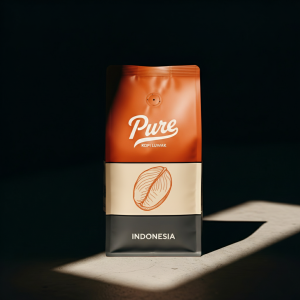
Pure Kopi Luwak
Wild-sourced. Organic. Arabica. From $100.
Wild kopi luwak produced in Sumatran highland forest represents some of the rarest expressions of the island’s terroir — the civet’s digestive transformation applied to beans that already carry significant complexity from volcanic soil and distinctive processing traditions.
Java: History and Quality in Highland Arabica
Java gave English the word java. The island was one of the earliest non-Arabian coffee sources for European markets, with the Dutch East India Company establishing plantations in the highlands of East Java in the 17th century. A catastrophic coffee leaf rust outbreak in the 1880s wiped out nearly the entire Typica arabica crop and forced a shift to disease-resistant Robusta across much of the island — a history still visible in Java’s coffee landscape today.
Modern specialty Java arabica, grown in the highlands of the Ijen Plateau, Dieng, and Tengger, has re-established the island’s reputation for quality. These highland environments — volcanic soil, 1,200 to 1,600 meters elevation, cooler temperatures — produce arabica with clean flavor, moderate acidity, and a distinctive sweetness that differs from Sumatran style. Estate-grown Java arabica often undergoes full washed processing, which produces more clarity and brightness than the wet-hulling methods common elsewhere in Indonesia.
Java is the primary source region for authentic wild kopi luwak of documented provenance. The island’s arabica character — already nuanced and clean — is an excellent base for civet processing, and the highland forest environment supports wild civet populations that can be collected from sustainably.
Sulawesi: Complexity and Controversy
Sulawesi Toraja and Kalosi coffees rank among Indonesia’s most complex origins. Grown in the mountainous central highlands above Rantepao, these coffees exhibit a wine-like character — developed acidity, dark fruit notes, and a deep finish — that distinguishes them sharply from Sumatran earthiness or Javanese clarity. Full-washed and wet-hulled lots both exist, producing a range of expressions within the Sulawesi origin.
Toraja coffees have attracted a devoted following in Japan, where the cultural connection between Sulawesi and Japanese specialty coffee runs decades deep. Several major Japanese roasters have maintained direct relationships with Toraja producers since the 1980s. The limited annual production and strong Japanese demand keep prices elevated relative to volume.
Bali, Flores, and the Emerging Islands
Bali produces arabica primarily in the Kintamani highlands, with a clean, bright profile influenced by the cool volcanic growing conditions and proximity to Lake Batur. Kintamani arabica carries a formal geographical indication in Indonesia and has built a following among specialty buyers who appreciate its consistent, accessible character.
Flores, particularly from the Bajawa and Manggarai regions, has emerged as a source of distinctive highland arabica with chocolate and spice notes. Limited production and improving processing infrastructure have made Flores coffee a favorite among adventurous specialty buyers. Papua’s Wamena and Baliem Valley coffees, grown by indigenous communities in remote highland terrain, offer rare and complex profiles that are gaining international recognition.
Where Kopi Luwak Fits the Hierarchy
Kopi luwak does not compete with Indonesian regional coffees in the conventional specialty grading framework — it transcends it. The SCA’s cupping protocols assess aroma, flavor, aftertaste, acidity, body, balance, uniformity, clean cup, and sweetness; they were not designed to account for the specific chemistry of civet-processed beans. When professional cuppers evaluate authentic wild kopi luwak within this framework, it typically scores above 85 — but its most distinctive qualities, the result of enzymatic transformation during digestion, aren’t fully captured by a framework designed around conventionally processed coffee.
What kopi luwak represents in the context of Indonesian coffee is not a regional origin competing with Mandheling or Toraja — it’s a category apart, defined by a production method that starts with Indonesian arabica excellence and applies a transformation unavailable to any other coffee on earth. For context on how kopi luwak compares to the world’s other premium options, see our guide to the most expensive coffee beans. For the brewing approach that best reveals Indonesian arabica’s regional characteristics in kopi luwak, our French press guide is the starting point.
Pure Kopi Luwak
Wild-sourced. Organic. Arabica. From $100.