Every bag of kopi luwak that arrives at a serious home brewer prompts the same question: what grinder setting do I use? The answer isn’t quite the same as for conventional specialty coffee, and for a reason that’s actually interesting — civet-processed beans behave differently on a burr grinder than unprocessed beans from the same origin.
The reason is enzymatic. During the 12 to 24 hours a wild civet’s digestive tract processes coffee beans, proteolytic enzymes in the animal’s stomach break down specific proteins in the bean’s outer cellular structure. Those proteins are the same ones that, during roasting, become bitterness precursors — and their partial hydrolysis is what produces kopi luwak’s characteristic low-bitterness profile. But softer cellular structure also means softer beans. They resist the grinding disc differently. If you grind kopi luwak at the same burr setting you use for regular specialty coffee, you’ll get a finer output than you expect — and fine-ground kopi luwak brewed in a French press is a recipe for over-extraction and the exact bitter finish you paid $125 to avoid.
The Standard Grind Size Reference
Coffee grind sizes are measured in microns (µm) — the average diameter of a ground particle. A coarse French press grind runs 1,000 to 1,300 microns. A medium-coarse grind for Chemex sits around 700 to 900 microns. Medium for drip and most pour-overs is 500 to 650 microns. Medium-fine for V60 or other thin-filter pour-overs falls between 400 and 500 microns. Fine for espresso is 200 to 350 microns, depending on the machine and roast level.
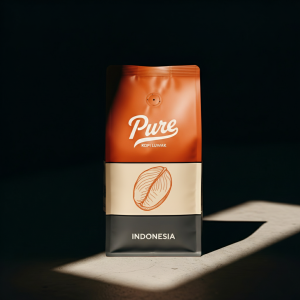
Pure Kopi Luwak
Wild civet coffee from Java. 88.5 SCA cupping score. From $125 for 100g.
These measurements assume conventionally processed specialty coffee — washed, natural, or honey process. Kopi luwak’s softer bean structure means that a burr grinder set for “coarse French press” will produce grounds in the 800 to 1,000 micron range rather than the 1,000 to 1,300 range you’d see from a washed Ethiopian or a conventional Javanese Arabica. This has real consequences for extraction timing and flavor balance.
Method-by-Method Recommendations
For French press, use a noticeably coarse grind — one or two clicks coarser on a stepped burr grinder than your usual French press setting. You’re aiming for approximately 1,000 to 1,200 microns in the finished output, which means compensating for the softer bean structure by setting the grinder coarser. The goal is to ensure a 4-minute full immersion extracts cleanly, without over-extracting through the more porous, enzyme-modified cells. If your spent grounds taste bitter after the brew, coarsen the grind. If they taste sour or astringent, go slightly finer.
For pour-over — V60, Kalita Wave, or similar thin-filter drippers — you want medium-fine, one notch coarser than your normal pour-over grind. The standard V60 technique involves three to four pours over three minutes, and with kopi luwak’s softer bean, a standard medium-fine grind risks channeling and over-extraction during the first pour. Going slightly coarser slows flow without sacrificing extraction completeness.
For Chemex, which uses a thick paper filter and naturally slows extraction, the medium-coarse recommendation holds — but again, one notch coarser than for regular Arabica. Chemex is actually a forgiving brewer for kopi luwak: the slow, controlled extraction through a thick paper filter smooths out any inconsistencies from the softer bean structure and produces a clean, full-flavored cup with consistent results.
For espresso, grind adjustment is non-negotiable. Civet-processed beans will choke an espresso machine if ground at normal fine settings — the softer cells compact more densely in the portafilter, restricting flow well beyond the 25 to 30 second target. Start two to three steps coarser than your regular espresso setting and dial in from there, aiming for a 25 to 30 second pull with approximately 7g of grounds at 9 bar pressure. The result — kopi luwak as espresso — is silky and low-acid, with dark chocolate notes that a regular shot rarely achieves. Budget for a few doses during dial-in; it’s worth the adjustment.
Fresh Grinding Is Non-Negotiable
For any premium coffee, the gap between fresh-ground and pre-ground matters. For kopi luwak at $12 to $15 per cup, it’s a genuine commitment. Volatile aromatic compounds begin dissipating the moment beans are ground — within 15 minutes, a measurable portion of the coffee’s characteristic fragrance has escaped. Within 30 minutes, the grind is noticeably flat. Within an hour, you’re brewing something that used to be kopi luwak.
Grind immediately before brewing. Use a burr grinder rather than a blade grinder — blade grinders produce inconsistent particle sizes that extract unevenly, creating both under-extracted and over-extracted compounds in the same cup. With wild Javanese kopi luwak, you’re working with 100g of something rare and carefully produced. An entry-level burr grinder treats that investment appropriately. A blade grinder does not.
One Practical Test
If you’re uncertain whether you’ve ground coarsely enough: after brewing, taste the spent grounds. Over-extracted grounds taste unmistakably bitter. Under-extracted grounds taste sour or astringent. Correctly extracted grounds taste flat and neutral — the good compounds left with the brew. If your used kopi luwak grounds taste bitter, coarsen your grind for next time. If they taste sour, go slightly finer. The bean will tell you, and that feedback is worth more than any dial setting on the grinder.
Pure Kopi Luwak
Wild civet coffee from Java. 88.5 SCA cupping score. From $125 for 100g.

Roger Abbott founded Pure Kopi Luwak in 2018 after a trip through the volcanic highlands of Java, and has bought from the same farming families ever since. He only works with collectors of wild civet coffee, never caged. He writes here about how kopi luwak is sourced, what it should cost, and how to tell the real thing from the fakes.