A Fairtrade certification reaches the coffee farmer as an average premium of approximately $0.20 per pound of green beans above commodity prices. On a market where Arabica has traded between $1.50 and $3.00 per pound, that additional twenty cents represents real but modest income improvement for growers who produce the majority of the world’s coffee on smallholder farms in vulnerable communities. Fairtrade does meaningful work. But the mechanism is a label, applied through periodic audits, to a supply chain that remains long, opaque, and fundamentally disconnected from the consumer holding the cup.
Wild kopi luwak doesn’t work that way. It’s one of the few premium coffee products where the supply chain is short enough to understand completely, where animal welfare and product quality are economically aligned rather than in tension, and where buying the product is a direct argument for preserving the habitat that makes it possible.
The Supply Chain That Can Actually Be Traced
The production path for genuine wild-sourced kopi luwak involves a wild Asian palm civet (Paradoxurus hermaphroditus) foraging on or near a coffee farm, consuming ripe cherries voluntarily, and depositing the processed beans. A farmer or collector gathers the beans from the forest floor, hand-sorts, washes, sun-dries, and hulls them. A small-batch roaster applies a medium roast calibrated to preserve the enzymatic modifications while developing flavor. The final product ships directly to the consumer.
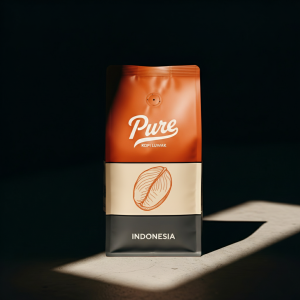
Pure Kopi Luwak
Wild civet coffee from Java. 88.5 SCA cupping score. From $125 for 100g.
By the standards of most agricultural supply chains, that’s remarkably short. There are no anonymous middlemen between the civet and the cup. There is no container-load blending, no audit gap between a certification claim and actual practice. The buyer can ask specific questions — which farm, which forest margin, what elevation, what variety — and receive specific answers. The transparency is structural, not a marketing layer applied after the fact.
Why the Civet’s Welfare and Product Quality Are the Same Question
Most ethical food certifications attempt to align animal welfare and production economics through third-party requirements: standards are mandated, inspections conducted, penalties applied. The compliance incentive is regulatory, not intrinsic. Producers do what’s required because it’s required, not because better animal welfare directly produces a better product.
Wild kopi luwak inverts this relationship entirely. A stressed or unhealthy wild civet doesn’t produce good kopi luwak. A civet that is caged and force-fed — as in commercial plantation operations — cannot perform the selective cherry-eating behavior that defines the quality of the raw material. Its digestive chemistry is compromised by stress hormones and inadequate diet variety. The enzymatic modification that produces kopi luwak’s smoothness, reduced bitterness, and specific flavor complexity requires a wild animal in good condition, processing high-quality food it chose to eat.
For the farmer producing genuine wild kopi luwak, maintaining healthy, free-ranging civet populations on the farm is not an ethical obligation — it is a direct production requirement. A farm that poisons or displaces its local civets in favor of caged animals will produce inferior product. The economic incentive to maintain wild animal populations is built into the production model in a way that no third-party certification creates artificially.
Try the coffee this article is about
Wild-sourced from Java, 88.5 SCA cupping score, free US shipping. From $125 for 100g.
Shop Pure Kopi Luwak →The Conservation Economics
The Asian palm civet is listed as “Least Concern” on the IUCN Red List, with a wide distribution across South and Southeast Asia. But its habitat in Java and Sumatra — the forest edge zones that border coffee farms — is under significant pressure from palm oil expansion, which has converted millions of hectares of mixed-use agroforestry landscape into monoculture over the past two decades.
For smallholder farmers on the margins of Java’s coffee-growing regions, the choice between maintaining forest edges that support civet populations and clearing those margins for additional palm oil cultivation is often economically close. If the civet produces nothing of value, the economics favor clearing. If the civet produces wild kopi luwak — currently selling at $100 to $200 per 100 grams at retail — the economics reverse. The forest margin that supports the civet becomes more valuable per hectare than the equivalent area under oil palm.
This is exactly the conservation argument most ethical certifications try to construct through third-party payments and incentives. Wild kopi luwak constructs it through the inherent economics of the product. The habitat stays because the habitat is worth keeping — a more durable argument than one that depends on a certification body maintaining its funding.
The Organic Question Without the Label
Wild civets avoid chemically treated fruit. This is an observed foraging behavior, not an advocacy claim. Animals that rely on acute olfactory detection of ripeness have evolved sensitivity to chemical contamination that makes pesticide-treated cherries unappealing or detectable as abnormal. Farmers who want their wild civet population to produce quality kopi luwak have a direct production incentive to avoid the synthetic inputs that would drive animals away from their trees.
The result is a product that is functionally organic without requiring third-party certification — the animal serves as a quality gate that organic inspections approximate through paperwork. Wild kopi luwak from Java carries no pesticide residues for the same reason that wild-caught fish carry no antibiotics: the production environment simply doesn’t involve them.
For buyers who want a premium coffee purchase with a clear, verifiable ethical story — and who have learned to be appropriately skeptical of certifications that don’t survive scrutiny — the case for authentic wild-sourced kopi luwak is not just about what’s in the cup. It’s about a supply chain where the cup and the conservation outcome are, unusually, the same answer to the same question.
Pure Kopi Luwak
Wild civet coffee from Java. 88.5 SCA cupping score. From $125 for 100g.
Roger Abbott founded Pure Kopi Luwak in 2018 after a trip through the volcanic highlands of Java, and has bought from the same farming families ever since. He only works with collectors of wild civet coffee, never caged. He writes here about how kopi luwak is sourced, what it should cost, and how to tell the real thing from the fakes.