In a Paris fragrance house, one of the standard exercises given to students of perfumery is to smell coffee. Not to describe the coffee, but to use it: coffee grounds are one of the most effective olfactory palate cleansers available, capable of resetting the nose between competing fragrances in a way that other common materials cannot. The reason has to do with coffee’s extraordinary aromatic complexity. Roasted coffee contains more than 800 identified volatile aromatic compounds — a number that exceeds wine, cocoa, and most other complex aromatic materials. The nose that is professionally trained to navigate thousands of individual fragrance molecules finds coffee, somehow, uncrowded and clarifying.
A perfumer or fragrance enthusiast who receives a bag of wild kopi luwak as a gift and opens it before brewing will not smell coffee the way most people smell coffee. They will smell approximately 800 compounds in some proportion, and they will identify a specific signature: the high-roasted note of 2-furfurylthiol, which researchers at Kanegrade and other flavor laboratories have identified as coffee’s single most characterizing aromatic molecule; the grounding backbone of pyrazines; the caramel warmth of furanone compounds; and, in genuine wild kopi luwak, something that departs from the standard profile in ways that a trained nose will catch before the first cup is brewed.
What Processing Does to the Aromatics
The aromatic profile of wild kopi luwak diverges from conventionally processed coffee at several points. During the 12 to 24 hours of gut transit through a wild civet’s digestive system, the coffee bean is exposed to a specific combination of proteolytic enzymes and microbial communities that modify the outer layers of the bean. These modifications alter which precursor compounds remain intact at the moment of roasting — and it is those precursors that determine, in part, which volatile aromatics develop during the roast.
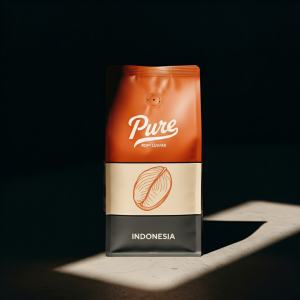
Pure Kopi Luwak
Wild civet coffee from Java. 88.5 SCA cupping score. From $125 for 100g.
The result, documented in food science research, is a modified aromatic signature: lower concentrations of the sharp citric and malic acid precursors that drive the bright, high-pitched notes in conventionally processed coffee, and a corresponding forward presence of the deeper, warmer compounds that form coffee’s chocolatey and earthy character. The cup smells of chocolate and damp earth and something rounder than usual, with the sharpest top notes in a regular Arabica softened or absent.
A perfumer will not need this explained. They will open the bag, inhale once, and locate the difference. The comparison they are most likely to make is to a fragrance where a dominant top note has been deliberately restrained to let the heart and base carry more weight — a structural decision that changes the character of the whole composition from bright and volatile to grounded and lasting.
Try the coffee this article is about
Wild-sourced from Java, 88.5 SCA cupping score, free US shipping. From $125 for 100g.
Shop Pure Kopi Luwak →The Parallel Between Sourcing and Perfumery
There is another dimension to this gift that a fragrance professional will appreciate: the sourcing story parallels the way rare aromatics are obtained for high-end perfumery. The most expensive fragrance ingredients in the world — aged oud from decomposed agarwood in Southeast Asia, ambergris from sperm whale digestive systems, civet musk from the anal glands of captive civets — all involve unusual biological processes, long timescales, and sourcing that cannot simply be scaled by applying more money to the problem.
Wild kopi luwak sits inside this tradition. The beans arrive at their final character through a specific biological process performed by a specific wild animal during a specific seasonal window, in a specific habitat at a specific elevation. The volcanic highlands of West Java, where the best wild Java kopi luwak is sourced, produce the raw material. The civet provides the transformation. The collector arrives in the pre-dawn hours to find what was left behind. None of this is replicable through industrial efficiency.
Anyone who has tried to source genuine aged oud or real Mysore sandalwood understands this problem intimately. The material either is what it is or it is a substitute wearing the right label. Wild kopi luwak is real in the same way: either it is genuinely wild-sourced and the aromatic profile reflects the biological transformation, or it is cage-farmed or mislabeled and the aroma tells that story too, usually in a flatness that training immediately detects.
How to Give This Gift
The most effective presentation for a fragrance professional is simply to let the product do the work. Hand them the bag before explaining it. Let them open it and smell it. Then, after they’ve responded to the aroma — which will be more complex and more immediate than most coffee gifts produce — explain what created that specific profile: wild sourcing, natural enzymatic processing, a biological transformation that modified the precursor compounds before the roast ever began.
A 100g bag of Pure Kopi Luwak is the right quantity for this purpose: enough for ten cups, which is enough to move from novelty to appreciation to understanding. The first cup establishes the character. The second cup, brewed slightly differently, clarifies it. By the fifth or sixth, the fragrance professional has done what they do with any complex aromatic material — mapped it, located it, understood it in relation to everything else they’ve smelled — and they will have a specific opinion about it, which is the mark of any gift worth giving.
Read more about what kopi luwak smells like before you brew it for a description of the raw aromatic profile — which is, for a perfumer, often the more interesting part of the experience than the cup itself.
Coffee is the only beverage whose aromatic complexity rivals fragrance. Wild kopi luwak, specifically, has an aromatic story that most coffee never gets to tell because it never underwent the transformation that makes it worth telling. For the person whose professional life is built on exactly that kind of story — rarity, biological specificity, the compound that changes everything — it is the obvious gift. The only question is whether to explain it before or after they smell it.
Pure Kopi Luwak
Wild civet coffee from Java. 88.5 SCA cupping score. From $125 for 100g.
Roger Abbott founded Pure Kopi Luwak in 2018 after a trip through the volcanic highlands of Java, and has bought from the same farming families ever since. He only works with collectors of wild civet coffee, never caged. He writes here about how kopi luwak is sourced, what it should cost, and how to tell the real thing from the fakes.