If you’ve spent any time researching kopi luwak online, you’ve probably noticed that prices vary wildly — from $15 for a small bag to $150 for the same apparent quantity. That range isn’t a sign of competitive pricing. It’s a sign of a market saturated with fake kopi luwak, where most of what’s sold has little to do with authentic wild-sourced civet coffee.
The fraud isn’t uniform. There are at least five distinct types of fake kopi luwak circulating the market — and understanding each one helps you know exactly what you’re risking when you buy. Some are outright counterfeits. Others are ethically compromised products sold under misleading labels. All of them represent a fundamental mismatch between what’s promised and what’s delivered.
Why the Kopi Luwak Market Is So Full of Fakes
Authentic wild kopi luwak is genuinely rare. Wild Asian palm civets roam freely through coffee-growing regions of Indonesia, eating ripe coffee cherries as part of their natural diet. The seeds pass through their digestive system, are collected from the forest floor by local farmers, and processed by hand. The yield per animal is tiny. The geography is remote. The labor is intensive.
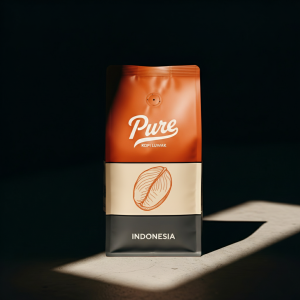
Pure Kopi Luwak
Wild-sourced. Organic. Arabica. From $125.
This scarcity creates an almost irresistible opportunity for fraud. Global demand for the world’s most famous coffee far outstrips the supply of authentic product. Profit margins on a convincingly labeled fake are enormous. And because most buyers have never tasted genuine kopi luwak, the deception is easy to sustain indefinitely.
The 5 Types of Fake Kopi Luwak
1. Completely Mislabeled Coffee
The most common type of fraud is also the most brazen: regular Indonesian or Sumatran coffee repackaged and sold as kopi luwak. No civet ever touched it. The only thing civet about it is the label — typically featuring the animal or some variation of the words “luwak” or “musang.” These products appear online and in tourist markets across Bali, Yogyakarta, and Jakarta, often priced to seem like a bargain. Most buyers never learn the difference.
2. Cage-Farmed “Kopi Luwak”
Cage farming is the kopi luwak industry’s worst-kept secret. Civets are captured from the wild and confined in small wire cages, force-fed coffee cherries on a commercial schedule. The result is technically civet-processed coffee — but it is not wild-sourced, and the product quality reflects that. Stressed animals have disrupted digestive systems. The natural fermentation that makes wild kopi luwak distinctive is compromised, and the end product is often flat, bitter, or simply unremarkable. More importantly, cage-farmed coffee is sold as authentic kopi luwak when it isn’t — it’s a fundamentally different and inferior product produced through genuinely cruel farming conditions.
3. Artificially Flavored Blends
A step further into the counterfeit spectrum: regular coffee with chemical flavoring added to approximate the smooth, low-acid, slightly earthy profile associated with genuine kopi luwak. These products sometimes carry “kopi luwak flavor” language in small print — or carry no disclosure at all. They’re frequently found in gift shop packaging and marketed heavily to tourists who won’t be able to compare the taste until they’re already home.
4. Diluted Blends
Some sellers use a small amount of real kopi luwak — often cage-farmed — mixed in large proportions with ordinary commodity coffee. The blend is then sold as pure kopi luwak. The buyer gets a product that may be 5–15% genuine article, paying full kopi luwak prices for what is essentially a premium-labeled filler blend. This type of fake kopi luwak is particularly difficult to detect without laboratory analysis.
5. Vague “Civet Coffee” Marketing
The final type isn’t always deliberate fraud — it’s strategic opacity. Products marketed with civet imagery, references to “civet coffee,” or vague Indonesian provenance claims, but without any specific sourcing information. In most cases these products are cage-farmed at best. But the marketing is deliberately designed to imply wild-sourced authenticity without actually claiming it — which provides legal cover while systematically misleading buyers.
The $75 Floor: The One Rule That Cuts Through Everything
You can spend hours evaluating certifications, labels, and seller claims — or you can apply a single rule that eliminates most fakes immediately: authentic wild kopi luwak cannot be legitimately sold for less than $75 per 100 grams.
This isn’t a marketing position. It’s arithmetic.
We’ve sourced kopi luwak directly in Indonesia and spoken with virtually every producer and exporter operating in this space. The supply chain for genuine wild-sourced product has a hard cost floor. Collection is labor-intensive and geographically remote. Processing and quality grading are done entirely by hand. Yield per civet is unpredictably small. There is no factory. There are no bulk discounts. The economics of authentic wild kopi luwak simply do not allow for cheap pricing at any scale.
Anything priced significantly below $75 per 100g is almost certainly one of the five fake types described above. We break down exactly why in our companion piece on why cheap kopi luwak is almost always fake — including the specific cost breakdown that makes low-price claims economically impossible.
How to Verify Authenticity Before You Buy
Beyond price, authentic producers have something fakes cannot easily replicate: a sourcing story that holds up under scrutiny.
When evaluating a kopi luwak seller, ask these questions directly:
- Where specifically is this sourced? Region, island, altitude. Real sellers know. Vague answers like “Indonesia” or “Sumatra” without further detail are a yellow flag.
- Do you have photos from the farm or collection area? Authentic wild-sourced producers can show you what the production process actually looks like — forest terrain, civet scat collection, hand-processing stages.
- Can you explain your processing method? Wild kopi luwak is collected from the forest floor, thoroughly washed, sun-dried, hulled, and sorted by hand. If a seller can’t walk you through this with any specificity, something is wrong.
- Is this wild-sourced or farmed? An honest seller will tell you directly and without hesitation. If they dodge the question or answer with words like “natural” or “free-range” without elaborating, be skeptical.
Traceability is the hallmark of authenticity. Genuine producers are proud of their sourcing and eager to share it. Sellers of fake kopi luwak tend to be vague precisely because specificity would expose them.
If you’re ready to experience genuine wild-sourced kopi luwak — fully traceable, ethically collected, and honestly priced — you’ve found the right source.
Continue Reading
Pure Kopi Luwak
Wild-sourced. Organic. Arabica. From $125.

Roger Abbott is the founder of Pure Kopi Luwak. He has spent over a decade sourcing wild kopi luwak directly from farmers and collectors in the highlands of Java, Indonesia — working exclusively with wild civets, never caged. He writes about specialty coffee, Indonesian origins, and the science behind what makes kopi luwak taste the way it does.
