Somewhere between the first Google result about civet digestion and the second article calling it overpriced novelty, most people form a settled skepticism about kopi luwak before they’ve tasted it. That’s understandable. It’s also worth interrogating. The common objections to wild kopi luwak are not all wrong — some contain real concerns — but most rest on assumptions that don’t hold up under examination. Here’s what each one actually gets right and wrong.
“It’s Just a Gimmick. There’s No Real Difference.”
This is the most common objection and the one with the weakest empirical foundation. The claim that kopi luwak tastes identical to regular coffee from the same origin is testable, and multiple independent food chemistry studies have tested it.
The differences are chemically measurable. Research published in peer-reviewed food chemistry literature has documented lower concentrations of malic and citric acids in authentic kopi luwak compared to conventionally processed Arabica from the same Javanese farms. The mechanism is proteolysis — digestive enzymes in the civet’s gut partially hydrolyze specific proteins in the outer layers of the bean that are precursors to bitterness compounds during roasting. This isn’t a subtle marketing claim. It produces a cup that is measurably smoother and lower in bitterness than a control sample from the same harvest.
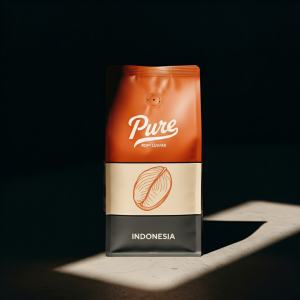
Pure Kopi Luwak
Wild civet coffee from Java. 88.5 SCA cupping score. From $125 for 100g.
The “gimmick” objection is partially correct in one specific context: low-quality or cage-farmed kopi luwak, which accounts for more than 80 percent of what’s sold globally under the name, often tastes undistinguished. If your experience with kopi luwak was a tourist café in Bali charging $10 for an unmarked “civet coffee,” you almost certainly tasted a product with no provenance, no freshness, and no genuine wild-sourced bean in it. That version is a gimmick. The real thing isn’t.
“It’s Unsanitary. You’re Drinking Coffee That Came Out of an Animal.”
The sanitation concern has the shortest response: coffee is roasted at temperatures between 190°C and 230°C for 8 to 15 minutes. At 100°C — less than half the roasting temperature — all known bacterial pathogens are killed within minutes. The roasting process doesn’t just neutralize contamination risk; it obliterates it entirely, along with any trace of the collection process.
Between collection and roasting, authentic wild kopi luwak is also thoroughly washed multiple times and sun-dried before processing begins. The sanitation chain is extensive. The concern is intuitive but not grounded in any actual risk. If you’re comfortable eating honey (produced in a bee’s stomach) or drinking wine fermented by wild yeast strains living on grape skins, the analogous concern with kopi luwak is similarly resolved by the nature of the final product rather than the nature of its production process.
Try the coffee this article is about
Wild-sourced from Java, 88.5 SCA cupping score, free US shipping. From $125 for 100g.
Shop Pure Kopi Luwak →“It’s Just Expensive Because of the Story. You’re Paying for Marketing.”
The price of wild kopi luwak — which can reach $1,300 per kilogram at wholesale for genuinely wild-collected beans — is often attributed to clever marketing of an otherwise unremarkable product. The actual cost structure doesn’t support that reading.
Consider the production constraints. Java’s Arabica harvest runs from May to September — roughly five months. Within that window, collection from wild civets happens during early morning rounds by farm workers covering unpredictable routes determined by the animals’ foraging behavior the previous night. A wild civet might eat 50 to 100 cherries in a night’s foraging. Over the entire collection window, the total yield from wild civets on a given farm is a tiny fraction of what human harvesters collect from the same trees. The collection is labor-intensive, yields are inherently low, and the product cannot be scaled by simply expanding the operation. You cannot add more wild civets on demand. The scarcity is real.
Add to this: the specialized cleaning and washing process, careful medium-roasting to preserve enzymatic modifications (dark roasting destroys them), small-batch production, and the cost of international shipping from Java. Wild kopi luwak commands a premium because producing it at all is expensive, not because someone made the price up.
“Most of It Is Fake Anyway. What’s the Point?”
This objection is accurate about the market and wrong about the conclusion. It’s true that more than 80 percent of coffee sold as kopi luwak globally is misrepresented — cage-farmed, blended with conventional coffee, or fraudulent. That problem is real.
But the conclusion that “most of it is fake, therefore none of it is worth pursuing” is the wrong move. The correct conclusion is: buy from verified, transparent sources with traceable wild origins and genuine freshness documentation. The fakery in the market isn’t an argument against the product. It’s an argument for knowing exactly where your bag comes from. The difference between wild-sourced and cage-farmed kopi luwak is both an ethical and a quality issue — and it’s entirely resolvable by choosing a seller whose sourcing chain is verifiable.
“I Could Get a Better Coffee Experience for the Same Money.”
This comparison usually involves a high-end espresso machine, a bag of Panama Geisha, or a specialty café tasting menu. Each is a reasonable alternative that satisfies different wants.
What they don’t produce is the specific experience of wild kopi luwak: a coffee that is processed by biology rather than by roaster craft, that starts with a different chemical profile rather than just a different cultivar, that delivers smoothness through a mechanism that no brewing parameter or roast technique can replicate. If what you want is a fruity, complex, high-SCA-scoring specialty coffee, a Panama Geisha is a better answer. If what you want is the particular smoothness that comes from enzymatic processing of peak-ripe cherries by a wild animal on a Javanese farm, there is no equivalent at any price. The comparison only makes sense if you’re optimizing for the same thing, which you aren’t.
The skeptical position toward kopi luwak is easy to hold if you’ve never had the authentic version. It’s considerably harder to maintain once you have. Wild-sourced kopi luwak from verified Javanese origins doesn’t ask you to suspend your standards. It asks you to apply them more precisely.
Pure Kopi Luwak
Wild civet coffee from Java. 88.5 SCA cupping score. From $125 for 100g.
Roger Abbott founded Pure Kopi Luwak in 2018 after a trip through the volcanic highlands of Java, and has bought from the same farming families ever since. He only works with collectors of wild civet coffee, never caged. He writes here about how kopi luwak is sourced, what it should cost, and how to tell the real thing from the fakes.