Flores is the Indonesian island where Komodo dragons still roam, where the three-colored volcanic lakes of Kelimutu change hue with atmospheric chemistry, and where smallholder coffee farmers in the Ngada regency have been growing arabica on volcanic hillsides at 1,200 to 1,800 meters elevation for well over a century. Flores coffee is not yet as internationally famous as Java, Sumatra, or Sulawesi — it has the quiet anonymity of a great producer not yet overrun by demand — and Flores kopi luwak is rarer still, produced by wild civets in quantities so small that most specialty buyers outside Indonesia have never encountered it.
That is precisely what makes it interesting.
The Bajawa Plateau: Where Flores Coffee Originates
The Bajawa plateau in the Ngada district of central Flores is the island’s most important coffee-growing area. At elevations ranging from 1,200 to 1,800 meters above sea level — occasionally exceeding 2,000 meters for the highest farm plots — Bajawa’s arabica grows under conditions of cool temperatures, volcanic soil, and intermittent cloud cover that slow cherry maturation to a crawl. This slow ripening is where flavor concentration happens: the longer a coffee cherry takes to ripen, the more time photosynthesis has to build sugars, and the more complex the eventual cup.
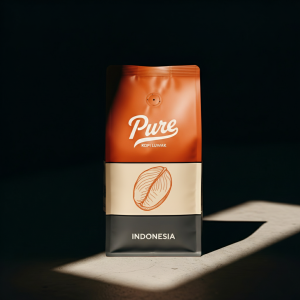
Pure Kopi Luwak
Wild civet coffee from Java. 88.5 SCA cupping score. From $125 for 100g.
The dominant coffee varieties cultivated in Bajawa include S795 Flores (a variety developed specifically for Indonesian highland conditions), Typica, Catimor, and Timor hybrids. Smallholders plant under shade trees — primarily Casuarina and Erythrina species — that regulate soil temperature and provide leaf litter for organic matter. The farming system is traditional, low-input, and entirely dependent on manual labor for selective cherry picking, which is why Flores coffee remains limited in supply despite growing international recognition.
Bajawa coffee has distinct flavor character from the volcanic mineral-rich soils of the Ngada regency: clean, medium-bodied, with bright apple-like acidity, brown sugar sweetness, and occasional floral notes that distinguish it from the deeper, earthier profiles of Sumatra or Sulawesi. Flores arabica is often described as a bridge between Indonesian coffees’ characteristic earthiness and the clarity of washed coffees from East Africa — approachable for drinkers who find Sumatran wet-hulled coffees too heavy, but with more depth than coffees from lighter-soil origins.
Try the coffee this article is about
Wild-sourced from Java, 88.5 SCA cupping score, free US shipping. From $125 for 100g.
Shop Pure Kopi Luwak →Wild Civet Production on Flores: Scale and Method
Asian palm civets inhabit Flores’s highland forests and coffee-growing areas, and small-scale wild kopi luwak collection has existed on the island for decades. The production model is consistent with other Indonesian origins: civets forage through coffee farms at night, selecting ripe cherries from the highest-accessible branches, and leave processed beans in their droppings on the farm floor or surrounding forest edge. Farmers collect these deposits during morning rounds, wash them thoroughly under fresh running water, sun-dry them on raised beds, and aggregate the small daily yields into seasonal lots.
The quantities are genuinely tiny. A single Flores wild kopi luwak producer might collect 100-200 grams of raw beans per day during peak harvest, amounting to a few kilograms per month at most. Scaled across the handful of farms in Bajawa that practice wild collection, the entire Flores wild kopi luwak production in a given year might amount to a few hundred kilograms — compared to tens of thousands of tons of conventional Flores arabica exported annually. This is not artificial scarcity. It is the actual yield of a biological process that cannot be industrialized without destroying what makes it valuable.
What Flores Kopi Luwak Tastes Like
Flores kopi luwak inherits the base character of Bajawa arabica — the clean acidity, the sugar sweetness, the volcanic mineral notes — and modifies it through the same civet digestive processes documented for other Indonesian origins. Proteolytic enzyme activity in the civet’s gut reduces bitter protein precursors; organic acid concentrations, particularly malic and citric acids, are lower in civet-processed beans than in conventionally processed beans from the same farms; the result is a cup that retains the clarity and brightness of Bajawa arabica but with significantly reduced bitterness and a smoother finish.
Compared to Javanese or Sumatran kopi luwak, Flores kopi luwak tends to be lighter-bodied and brighter — more transparent in the cup, with the mineral and floral notes of the high-altitude Bajawa terroir coming through more clearly than the dense earthiness of lower-altitude or wet-hulled origins. For specialty coffee drinkers who find traditional kopi luwak too earthy or heavy, Flores provides a point of entry into wild civet coffee that aligns with the flavor preferences of third-wave specialty culture.
Why Flores Remains Under the Radar
Flores coffee in general — not just kopi luwak — has struggled with infrastructure and market access in ways that Java and Sumatra have largely solved. The island’s road network is still developing in highland areas, cold-chain logistics are limited, and the smallholder structure of production means no single large entity is marketing Flores coffee aggressively to international buyers. The coffee that does reach export markets often travels under generic “Indonesian arabica” blends, losing its terroir identity in the process.
For specialty buyers, this obscurity is an opportunity. Flores arabica is frequently underpriced relative to its quality, and specialty roasters who have sourced it directly — bypassing the commodity aggregation pipeline — find a consistent, high-quality origin that their competitors aren’t using. Flores kopi luwak, even further along the niche spectrum, occupies a category where authenticity and rarity combine in a way that few Indonesian origins can match.
If you are interested in comparing Flores kopi luwak with the Javanese highland arabica that forms the basis of Pure Kopi Luwak, the key difference is terroir: Flores brings Bajawa volcanic clarity, Java brings Priangan volcanic depth. Both are genuinely wild-sourced, both are arabica, and both represent Indonesian coffee at a quality level that the bulk market cannot reach. For a broader look at how Indonesia’s island origins differ from each other, the Indonesian coffee guide maps the full spectrum. And for the processing science behind what makes civet-processed coffee different from conventionally processed coffee on the same island, how civets select coffee cherries explains the biological mechanism.
Pure Kopi Luwak
Wild civet coffee from Java. 88.5 SCA cupping score. From $125 for 100g.

Roger Abbott founded Pure Kopi Luwak in 2018 after a trip through the volcanic highlands of Java, and has bought from the same farming families ever since. He only works with collectors of wild civet coffee, never caged. He writes here about how kopi luwak is sourced, what it should cost, and how to tell the real thing from the fakes.