The volcanic highlands of West Java, known historically as the Priangan or Parahyangan, are where Java’s coffee story began. In the early 1700s, after a first planting near Batavia failed, the Dutch distributed arabica seedlings to local rulers in these cooler mountain districts, and the coffee that came back down to the ports was shipped to Europe as “Java Preanger.” It helped make “Java” a word for coffee itself. Three centuries later, the same highlands, ringed by volcanoes such as Tangkuban Perahu, Papandayan, Malabar and Cikuray, are where Pure Kopi Luwak’s coffee is collected from wild civets.
The landscape is not a scenic detail. The altitude and the volcanic soil are the mechanism that explains the quality of the arabica grown there, and by extension, the quality of what wild civets in that region select and process. Understanding the West Java highlands is the most direct path to understanding why authentic Javanese wild kopi luwak tastes the way it does, and why cheaper kopi luwak from caged animals or lowland farms does not reliably produce the same result.
What Elevation Does to a Coffee Cherry
Coffee grown at higher elevations ripens more slowly than coffee grown lower down. Air temperature drops as you climb, and in West Java’s coffee country, where arabica is commonly grown between roughly 1,000 and 1,800 meters, the cooler days and cool nights stretch out the time a cherry spends developing on the branch. That extended development period has a direct effect on flavor complexity.
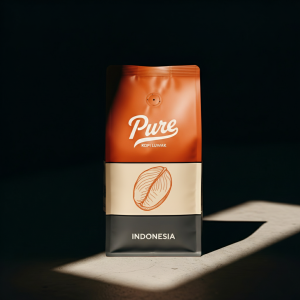
Pure Kopi Luwak
Wild civet coffee from Java. 88.5 SCA cupping score. From $125 for 100g.
As a coffee cherry ripens, it accumulates sugars and organic acids in both the fruit and the seed. A slower maturation gives those compounds more time to build and balance. This is why high-grown arabica tends to cup with more sweetness, more structured acidity and more aromatic depth than the same variety grown in warm lowlands. The relationship between altitude and cup complexity is well established across the world’s coffee origins, and it holds in Java too.
West Java’s highland arabica ripens slowly under these conditions, developing dense, aromatic cherries that lowland coffee simply does not match. This is the fruit that wild civets foraging in the region have access to. The elevation creates the raw material; the civets select the best of it.
The Priangan Highlands: Where Java Coffee Began
The Priangan is a broad upland region of mountains, valleys and plateaus running through the volcanic spine of West Java, from the peaks north of the central basin to the ranges further south and east. Under Dutch rule, coffee cultivation here was organized under a forced-delivery arrangement later known as the Preanger system, and for much of the 18th century these highlands supplied a large share of the coffee Europe drank. The arabica planted there descended from seeds brought from the Malabar coast of India, the same Typica line that later spread from Java to the Americas.
Today the region is a working agricultural landscape rather than a museum. Smallholder coffee gardens sit alongside vegetable plots, tea, shade trees and patches of forest on the volcanic slopes. That mix matters for wild kopi luwak. The Asian palm civet lives on the forested margins and moves through the coffee gardens at night during the harvest season, when ripe cherries are suddenly abundant. Shade cover, forest edges and unhurried harvesting create exactly the conditions that draw wild civets in and give them good fruit to choose from.
Try the coffee this article is about
Wild-sourced from Java, 88.5 SCA cupping score, free US shipping. From $125 for 100g.
Shop Pure Kopi Luwak →How the Civet’s Selectivity Compounds the Quality
The Asian palm civet (Paradoxurus hermaphroditus) is an opportunistic forager, and when coffee is in season it goes for the ripest, sweetest cherries it can find. It passes over unripe fruit and fruit that has started to spoil. In the West Java highlands, that means the civet is choosing from slow-ripened, high-grown arabica rather than from lowland fruit.
The result is a quality feedback loop that is specific to wild kopi luwak from highland regions. Elevation produces better cherries. Better cherries attract wild civets. Wild civets select the best of those cherries by scent and taste. The selected beans then pass through the animal’s digestive tract, where fermentation and enzyme activity alter the proteins in the bean, a change that is widely associated with lower bitterness in the finished cup.
This compounding is important. A wild civet selecting peak-ripe, high-grown arabica produces a more distinctive cup than the same animal eating lower-quality fruit. The digestive transformation works on superior raw material. The result is not just “kopi luwak.” It is kopi luwak that expresses the terroir of West Java’s volcanic highlands: full-bodied, chocolatey and earthy, with a smooth finish shaped by mineral-rich volcanic soil, slow ripening and the choices of a wild animal doing what it evolved to do.
Why Cage Farming Can’t Replicate This
Cage-farmed kopi luwak removes both of the variables that make wild highland kopi luwak distinctive. Caged civets are fed whatever cherries they are given, often from mixed or lower-grown sources, with no chance to forage selectively. They are also kept in conditions that are widely documented as poor for the animals’ welfare. The starting material is wrong, and the natural behavior that makes wild kopi luwak what it is has been taken away.
Cage farming can produce kopi luwak in volume. What it cannot produce is the combination of high-altitude volcanic terroir, selective wild foraging and natural processing that defines authentic wild product from West Java. These are not marketing distinctions. They are the actual mechanisms behind the difference in the cup.
Pure Kopi Luwak is 100% arabica, wild-collected in the volcanic highlands of West Java from civets that are never caged. It is not cage-farmed, not lowland-sourced and not a blend of origins. We roast twice a week, every batch is independently tested for pesticide residues, and in a blind SCA-protocol cupping by Q Arabica Grader Marcus Holt it scored 88.50/100. You can read the full cupping report. A 100 g bag is $125 and a 250 g bag is $250, with 14-day returns.
Java has more than one highland coffee region. For the history and structure of the colonial-era estates on the Ijen Plateau in East Java, a separate region from ours, see our guide to Java’s four government coffee estates. For a closer look at how wild civet selection works at the cherry level, see our piece on how civets choose their cherries.
Pure Kopi Luwak
Wild civet coffee from Java. 88.5 SCA cupping score. From $125 for 100g.
Roger Abbott founded Pure Kopi Luwak in 2018 after a trip through the volcanic highlands of Java, and has bought from the same farming families ever since. He only works with collectors of wild civet coffee, never caged. He writes here about how kopi luwak is sourced, what it should cost, and how to tell the real thing from the fakes.