In the late 1860s, a fungal pathogen called Hemileia vastatrix appeared in Ceylon and began moving through the coffee plantations of Asia with quiet efficiency. By 1879, it had reached Indonesia. By the early 1880s, it had traveled through Java, Sumatra, and across the Pacific. Arabica crops — centuries of cultivation, colonial infrastructure, entire regional economies — collapsed within a generation.
Two things happened as a direct result. Colonial plantation managers replanted heavily with Coffea canephora — Robusta — which resists the rust fungus and reliably produces volume. And in the Philippines, Malaysia, and parts of Indonesia, a third coffee species gained a foothold that it’s never quite relinquished: Coffea liberica, a large-leaved tree from West Africa that resists rust, tolerates humid lowland heat, and produces beans unlike anything else in the coffee world.
Today, those historical accidents have left Southeast Asia with two of the most unusual coffees available anywhere: wild kopi luwak, produced on Java’s Arabica-growing highland farms, and Liberica, still grown primarily in the Philippines, Malaysia, and pockets of Indonesia. Both are genuinely rare. Both carry premium prices. Both challenge you. They are otherwise almost completely different propositions.
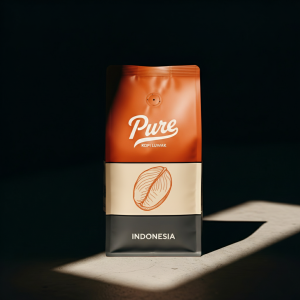
Pure Kopi Luwak
Wild civet coffee from Java. 88.5 SCA cupping score. From $125 for 100g.
What Liberica Actually Is
Liberica is the third commercial coffee species and accounts for approximately 2% of global coffee production. In the Philippines, where it’s called Barako or Kape Barako and originates primarily from Batangas province on Luzon, it has deep cultural roots — the name Barako translates roughly as “wild boar” or “virile man,” a reference to the coffee’s assertive character. In Malaysia, roughly 90% of domestically grown coffee is Liberica, much of it consumed locally in strong, condensed-milk preparations.
Outside Southeast Asia, it’s genuinely difficult to find, which is part of what makes it interesting to specialty coffee buyers willing to look.
The beans are unmistakable. They’re larger than Arabica — sometimes approaching twice the size — and they’re asymmetric, with an irregular, elongated shape that looks wrong if you’re accustomed to the neat oval of a standard coffee bean. The cherries are larger. The trees are larger, reaching heights of 9 meters without pruning, compared to Arabica’s manageable 3 to 5 meters.
In the cup, the character is bold and polarizing. Common descriptors include smoky, woody, floral, and anise-adjacent. Some tasters find tropical fruit underneath the structural flavors; others describe a slight fermented note that’s either fascinating or off-putting depending on your palate. The body is full and dense. The acidity is lower than standard Arabica but the flavor is wilder — less refined, more assertive. It is not a coffee you drink absent-mindedly.
Well-sourced premium Liberica runs from $20 to $50 per 100 grams, depending on the producer and origin specificity.
Try the coffee this article is about
Wild-sourced from Java, 88.5 SCA cupping score, free US shipping. From $125 for 100g.
Shop Pure Kopi Luwak →What Kopi Luwak Actually Is
Wild kopi luwak is, at its foundation, Arabica coffee — on Java, typically the Typica variety grown at elevations between 900 and 1,500 meters on volcanic basalt soils. The distinction isn’t the plant species. It’s what happens to the coffee after the cherries are ripe: a wild palm civet (Paradoxurus hermaphroditus) selects peak-ripe cherries exclusively, consuming and passing the intact beans through its digestive tract over 12 to 24 hours. During that passage, proteolytic enzymes partially hydrolyze proteins in the bean’s surface layers — reducing bitterness precursors, modifying the acid profile, and creating a chemical signature that no conventional processing method produces.
Research published in Scientific Reports in 2025 documented the specific fatty acid composition that distinguishes wild kopi luwak from standard fermented coffee, including elevated levels of compounds associated with creamy, dairy-like flavor characteristics. Separately, metabolomics studies have found higher concentrations of pyrazines and guaiacol derivatives in roasted kopi luwak compared with standard Arabica of the same origin — markers of greater aromatic depth and complexity.
Where Liberica’s unusual character comes from the plant’s own genetics, kopi luwak’s character comes from an third-party biological process applied to an already-premium Arabica. The civet’s selective foraging and enzymatic activity transform the bean before roasting begins. Wild kopi luwak starts at $125 for 100 grams — a reflection of production that cannot be scaled, since wild civets forage on their own schedule and cannot be managed for higher throughput.
Two Different Kinds of Rarity
Liberica is rare because not many producers grow it and not many markets stock it. Global production is small, but the crop is manageable. If demand for Liberica expanded significantly, supply could grow — the trees can be planted, cultivated, and harvested at increasing scale given the right economic conditions.
Wild kopi luwak is rare for structural reasons that resist any scaling solution. Global production of genuinely wild-sourced kopi luwak is estimated at approximately 500 kilograms annually. A wild civet forages within a home territory, consumes what it chooses, and the beans it passes are collected by hand from the forest floor. You cannot increase that throughput by hiring more people or buying more land. The limiting factor is the animal’s biology and its free-ranging behavior — which is precisely what creates the quality advantage over caged production.
Caged-civet kopi luwak exists at greater volume, but it’s a different product: stressed animals eating indiscriminate feed don’t process beans with the same enzymatic quality as wild civets eating peak-ripe fruit of their own choosing. The rarity and the quality are inseparable.
Which One to Buy
The right choice depends on what you’re actually after.
If you want a coffee that’s botanically unusual — a genuinely different species from a different branch of the genus Coffea, with structural characteristics and a bold, assertive, polarizing flavor profile — Liberica is worth experiencing, particularly if you can source a well-roasted Barako from a quality Philippine producer.
If you want the most refined cup a premium Arabica can produce — with a provenance story that’s genuinely irreplaceable and a flavor profile that rewards quiet attention — wild kopi luwak is a different category entirely. The smoothness is not a variety characteristic. It’s the result of a specific, studied biological process that changes the bean’s chemistry before roasting. That’s what the price reflects, and it’s what makes the comparison with Liberica ultimately unresolvable: they’re not competing for the same experience.
Liberica offers unusual plant. Kopi luwak offers unusual process. Both are legitimate and both reward the taster who approaches them with genuine curiosity — but they’re different kinds of interesting, and knowing which kind you’re after saves considerable confusion at the moment of purchase.
For more on how wild kopi luwak compares to other premium coffees across different dimensions, see our guides on kopi luwak vs Gesha and the full landscape of animal-processed coffees.
Pure Kopi Luwak
Wild civet coffee from Java. 88.5 SCA cupping score. From $125 for 100g.
Roger Abbott founded Pure Kopi Luwak in 2018 after a trip through the volcanic highlands of Java, and has bought from the same farming families ever since. He only works with collectors of wild civet coffee, never caged. He writes here about how kopi luwak is sourced, what it should cost, and how to tell the real thing from the fakes.