Brazil ships more coffee than any country on earth — roughly 37% of global supply by volume, most of it leaving through the port city of Santos, which is why the term “Brazil Santos” functions less as a specific origin name and more as a grade designation stamped on bags that range from commodity blends to respectable specialty lots. When you buy Brazilian coffee, you are almost certainly buying something that has been reliable, smooth, and affordable for decades. When you buy wild kopi luwak from Java, you are buying something that Brazil’s scale has made impossible to replicate anywhere.
That contrast — volume versus scarcity, predictability versus rarity — is what this comparison is actually about.
What Brazilian Santos Actually Is
Santos is the harbor through which the majority of Brazil’s coffee exports have moved since the nineteenth century, and the grade designation “Brazil Santos NY2” or similar refers to screen size, defect count, and cup quality rather than a specific farm or region. The coffee itself comes primarily from the states of Minas Gerais, São Paulo, and Espírito Santo, grown predominantly at relatively modest elevations — typically 900 to 1,200 meters, lower than the high-altitude Arabica farms of Ethiopia, Colombia, or Java.
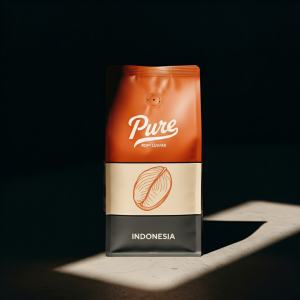
Pure Kopi Luwak
Wild civet coffee from Java. 88.5 SCA cupping score. From $125 for 100g.
Brazilian Arabica varieties — Bourbon, Catuai, Mundo Novo — are generally processed using natural (dry) methods, left to dry whole on raised beds in the sun. This imparts a characteristic sweetness and body, with flavor notes that regularly include milk chocolate, roasted nuts, brown sugar, and a low, soft acidity. It is genuinely good coffee at its best, and it has formed the backbone of espresso blends worldwide for good reason. A kilogram of specialty-grade Brazil Santos retails between $20 and $40 depending on roaster and provenance — and the best small-lot Brazilian coffees genuinely reward careful brewing.
What Kopi Luwak Actually Is
Wild kopi luwak from Java is Arabica coffee that has been selected by wild Asian palm civets (Paradoxurus hermaphroditus) on Javanese highland farms, consumed as ripe fruit, and passed through the civet’s digestive system over 12 to 24 hours. During that transit, proteolytic enzymes in the stomach break down specific surface proteins in the bean — the same proteins that contribute to bitterness during roasting. The resulting green bean, once cleaned and dried, roasts differently from a conventionally processed bean: lower inherent bitterness, modified acid content, and a smoother cup that many drinkers notice immediately compared to comparable origins.
Javanese kopi luwak is produced at highland elevations in the 800 to 1,500 meter range, using Arabica plants that thrive in the volcanic soils left by Central Java’s active geologic history. The typical flavor profile includes dark chocolate, caramel, and earthiness, with a full body and a finish that’s remarkably clean for how complex the cup is. A 100-gram bag of authentic wild-sourced kopi luwak retails at $125 to $199 — roughly ten times the cost per gram of specialty Brazil Santos.
The Processing Gap
Both coffees are Arabica. Both can be smooth, chocolatey, and full-bodied. What separates them isn’t origin alone — it’s what happens to the bean between cherry and cup.
Brazil’s natural processing is excellent at extracting sweetness from ripe cherries and producing a consistent, approachable cup. But the beans are dried as a batch, processed by the thousand ton, and sorted by defect count rather than by the kind of individual quality assessment that defines truly rare coffee. The volume that makes Brazil Santos available at every supermarket is the same volume that prevents any individual batch from being extraordinary.
Kopi luwak’s processing is the opposite in almost every dimension. Wild civets select perhaps 50 to 100 individual cherries per night, each one chosen by an animal whose survival depends on evaluating fruit quality accurately. The resulting beans are collected in small quantities, cleaned by hand, and processed in batches measured in kilograms rather than tonnes. The entire mechanism is the inverse of industrial production.
Who Should Buy Which
Brazil Santos, at its best, is one of the most reliable coffees in the world. If you want a daily driver — something you can grind each morning without performing arithmetic about cost per cup — it’s a strong answer. Specialty-grade Brazilian lots from roasters who source carefully offer genuine pleasure at reasonable prices.
If you’re buying a gift, marking a milestone, or simply want to know what the rarest accessible coffee in the world tastes like, the math changes entirely. Authentic wild kopi luwak from Java at $125 for 100 grams isn’t competing with Brazil Santos for daily-driver status. It’s offering something that volume production cannot produce: a cup where the processing history is unique, the quantity is genuinely limited, and the flavor reflects a biological intervention that no industrial method can replicate.
They aren’t really competing. One is infrastructure. The other is an experience. Pure Kopi Luwak, sourced exclusively from wild civets on Javanese farms, answers the question of what that experience actually tastes like.
For a broader look at how kopi luwak compares to other premium origins, see the world’s most expensive coffees, ranked. For context on what makes Javanese sourcing specific, the Sumatra vs Java comparison covers the regional differences in detail.
Pure Kopi Luwak
Wild civet coffee from Java. 88.5 SCA cupping score. From $125 for 100g.
Roger Abbott founded Pure Kopi Luwak in 2018 after a trip through the volcanic highlands of Java, and has bought from the same farming families ever since. He only works with collectors of wild civet coffee, never caged. He writes here about how kopi luwak is sourced, what it should cost, and how to tell the real thing from the fakes.