Walk into any specialty coffee shop in Lima’s Miraflores district and you’ll find Peruvian Arabica on the menu — typically a Cajamarca washed at 1,800 meters, priced around $22 per pound, scoring somewhere in the low-to-mid 80s on the SCA scale. It’s genuinely good coffee: clean, sweet, with a citric brightness that wakes you up without demanding anything of you. Peru produced approximately 4.35 million bags of Arabica in 2024/25, making it one of the top 10 coffee-producing nations by volume, and its organic-certified cooperative sector has quietly become a favorite among specialty roasters who want traceability and clean flavor profiles without paying Gesha-level prices.
Then there’s wild kopi luwak from Java — produced in quantities that can’t be measured in bags per hectare, sourced from nocturnal animals navigating the dark, and priced at roughly $1,250 per kilogram at Pure Kopi Luwak’s entry level. The comparison might seem unfair to Peruvian coffee. It isn’t. It’s actually the most clarifying comparison you can make when deciding how to spend money on premium coffee, because the two origins represent two completely different answers to the same question: what are you actually paying for?
What Peruvian Coffee Does Right — And Why It Has a Ceiling
Peru’s primary growing regions — Cajamarca in the north, Chanchamayo in central Peru’s Junín department, Amazonas in the northeast — produce coffees with distinct regional personalities. Cajamarca, the country’s most celebrated specialty zone at altitudes of 1,600 to 2,200 meters above sea level, yields beans with vanilla, molasses, and stone fruit notes. Chanchamayo runs cooler, producing moderate-bodied coffees with citrus and chocolate. Amazonas gives you dried fruit and caramel. All of them are washed process, which means the cup is clean and bright, with precise acidity that specialist roasters can develop to impressive results.
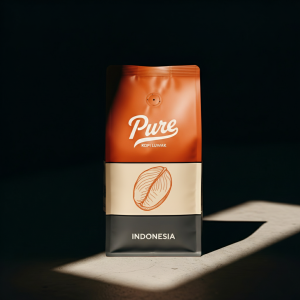
Pure Kopi Luwak
Wild civet coffee from Java. 88.5 SCA cupping score. From $125 for 100g.
Peru entered the Cup of Excellence competition in 2017 and has been producing award-winning microlots since. In recent Cup of Excellence auctions, top-scoring Peruvian lots have changed hands at over $100 per pound — proof that the country can reach genuine heights when farm management is meticulous and roasting is thoughtful. This is the ceiling: extraordinary care applied to naturally good terroir, producing a cup that specialists seek out and pay well for.
What Peruvian coffee cannot do is change its fundamental nature. It grows in soil, is picked, washed, dried, and roasted. The process is well-understood, scalable, and — at the quality end — demanding of precision. But the cup it produces is the cup of a good coffee, not the cup of a transformed one. Brightness, clean sweetness, terroir expression: these are the coordinates of Peruvian specialty, and they are genuinely appealing coordinates.
Try the coffee this article is about
Wild-sourced from Java, 88.5 SCA cupping score, free US shipping. From $125 for 100g.
Shop Pure Kopi Luwak →What Civet Processing Actually Changes
Wild kopi luwak starts at an advantage that Peruvian coffee cannot replicate: the Asian palm civet (Paradoxurus hermaphroditus) selects only peak-ripe cherries. Civets don’t harvest systematically — they smell, taste, and reject, consuming only the cherries in the optimal Brix window where dissolved sugars and acidity are in balance. The raw material entering the civet’s digestive system is, cherry by cherry, the best available on that particular farm that particular night.
Inside the civet, proteolytic enzymes begin breaking down specific proteins in the outer layers of the bean. Researchers at Universitas Syiah Kuala in Aceh found measurably lower concentrations of malic and citric acids in kopi luwak compared to conventionally processed beans from the same origin — which explains the characteristic smoothness. The protein hydrolysis also reduces bitterness precursors, producing a cup that tastes fundamentally different from what the same cherry would produce through standard processing. This is not a marginal improvement. It’s a different flavor architecture.
The result is a coffee that sits outside the normal coordinate system entirely. Where Peruvian Cajamarca’s brightness is its strength, wild kopi luwak’s smoothness and depth are theirs. They don’t compete along the same axis.
The Actual Price Comparison
A pound of exceptional Peruvian specialty — a Cup of Excellence-adjacent microlot from Cajamarca — might run $28-45. Standard high-quality Peruvian organic from cooperatives like CECOVASA or CENFROCAFE lands at $15-22 per pound. These are real prices for real coffee that will satisfy a specialty drinker every morning.
A 100-gram bag of wild Javanese kopi luwak at $125 works out to roughly $567 per pound — thirteen to twenty-five times the price of excellent Peruvian coffee. That ratio deserves honest scrutiny, and the honest answer is this: at the top of Peruvian specialty, you’re paying for everything human expertise can achieve. At the entry point of authentic wild kopi luwak, you’re paying for something human expertise cannot replicate at scale, cannot certify at volume, and cannot substitute with a better processing method.
Peruvian coffee’s price ceiling is set by terroir, labor, and roasting skill. Kopi luwak’s price floor is set by biological scarcity — a civet foraging fifty to a hundred cherries per night, across an Indonesian harvest season of five months. The math doesn’t compress.
Who Should Choose Which
Peruvian specialty is one of the best everyday premium options a serious coffee drinker can find. It’s traceable, certifiable, consistently excellent when sourced from the right cooperatives, and priced in a range where buying several bags for comparison is feasible. If your daily cup matters and you want clean, bright Arabica with real character, Peru deserves serious attention.
Kopi luwak is not an everyday premium option. It’s a specific purchase for a specific purpose: experiencing a flavor profile that doesn’t exist in the conventional specialty market, giving someone a gift that genuinely has no equivalent, or marking a moment that deserves something rarer than excellent. The tasting notes — low bitterness, dark chocolate, full body, minimal acidity — describe something that even the best Peruvian microlot, however extraordinary, won’t produce.
The comparison between the two isn’t a verdict on quality. It’s a clarification of purpose. Peruvian coffee asks to be drunk daily and appreciated carefully. Wild kopi luwak asks to be experienced deliberately and remembered. Both requests are legitimate. Knowing which one you’re answering determines which bag belongs in your cart.
Pure Kopi Luwak
Wild civet coffee from Java. 88.5 SCA cupping score. From $125 for 100g.

Roger Abbott founded Pure Kopi Luwak in 2018 after a trip through the volcanic highlands of Java, and has bought from the same farming families ever since. He only works with collectors of wild civet coffee, never caged. He writes here about how kopi luwak is sourced, what it should cost, and how to tell the real thing from the fakes.