By early 2026, used bourbon barrels had become one of the specialty coffee industry’s most sought-after inputs. Rocky Mountain Barrel Company, one of the largest secondary barrel markets in the United States, reported in February 2026 that demand for spent 53-gallon American oak containers had grown across fermentation industries — including, specifically, specialty coffee roasters using them to age green beans. The process takes six weeks to three months: green or lightly roasted coffee rests inside a barrel that previously held whiskey, rum, or wine, absorbing compounds from the wood before being roasted as normal.
The result is coffee that tastes unmistakably of its barrel history — oak, vanilla, smoke, and the ghost of whatever spirit came before it. The appeal is genuine. For a certain kind of coffee buyer, a whiskey-barrel-aged Ethiopian cup that bridges two sensory worlds is exactly the right product. But barrel aging has become dominant enough in specialty circles that it’s worth comparing directly to what it’s competing against — and what it’s replacing in the premium tier.
What Barrel Aging Actually Does to Coffee
The chemistry is worth understanding before you spend $60 on a bag. When green coffee rests in a used barrel, several things happen simultaneously. Vanillin, lignin, tannins, and oak lactones migrate from the wood into the bean. Residual spirit compounds — whatever whiskey, rum, or bourbon previously occupied the barrel — also transfer in trace amounts. Research on barrel aging chemistry published in PMC in 2025 confirmed that vanillin and trans-resveratrol concentrations increase measurably during barrel contact, while ellagic acid and other phenolic compounds fluctuate based on wood species and aging duration.
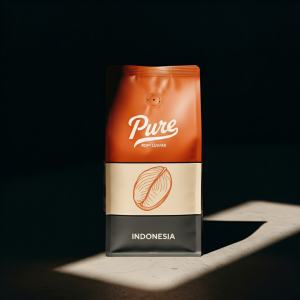
Pure Kopi Luwak
Wild civet coffee from Java. 88.5 SCA cupping score. From $125 for 100g.
In practical terms, this means barrel-aged coffee tastes like barrel-aged coffee. The added compounds — caramel, spice, vanilla, sometimes smoke — overlay whatever the original bean had to offer. A barrel-aged Colombian will taste of both Colombia and the barrel. A barrel-aged Kenyan will taste of both Kenya and the barrel. The barrel itself becomes a dominant variable.
Whether that’s desirable depends entirely on what you value in coffee. If you want your cup to taste of spirits and oak, barrel aging delivers. If you want to taste the coffee — its origin, its variety, its growing conditions — the barrel is working against you.
The Civet Gut vs the Bourbon Barrel: A Mechanism Comparison
Wild kopi luwak operates on a fundamentally different principle, and the contrast reveals something important about what each approach is actually doing.
When an Asian palm civet consumes a ripe coffee cherry, the bean passes through its digestive tract over roughly twelve to twenty-four hours. During that time, proteolytic enzymes in the civet’s stomach begin breaking down specific proteins in the bean’s outer layers. Those proteins are precursors to bitterness during roasting — their partial hydrolysis reduces the bitterness potential of the finished cup without adding any third-party compounds whatsoever.
The barrel is additive: it deposits flavors that weren’t in the original bean. The civet’s gut is subtractive: it removes inhibitory compounds that would otherwise get in the way of the bean’s natural flavor. These are opposite strategies, producing opposite results.
Research from the University of Nottingham, documented in Chemistry World in 2024, confirmed that kopi luwak contains higher proportions of citric and malic acids compared to conventionally processed coffee from the same origin. The enzymatic transformation isn’t random — it selectively modifies the compound profile in ways that reduce bitterness and sharpen the cup’s natural character rather than overlay it with third-party flavors.
Try the coffee this article is about
Wild-sourced from Java, 88.5 SCA cupping score, free US shipping. From $125 for 100g.
Shop Pure Kopi Luwak →The Rarity Question
Barrel-aged coffee is a manufacturing decision. A roaster buys some barrels, fills them with green coffee, waits a few weeks, then roasts as normal. The production ceiling is essentially the number of barrels they can source. The scarcity is artificial — priced in, not inherent.
Wild kopi luwak cannot be manufactured at volume. Wild Asian palm civets cover large territories, forage nocturnally, and select their cherries individually — a single civet might consume 50 to 100 cherries on a good night, compared to a skilled human picker who can process kilograms of mixed-quality fruit per hour. The animal’s selectivity is the quality mechanism. It cannot be scaled, replicated, or accelerated. The rarity of genuine wild kopi luwak is structural, not marketing.
A specialty barrel-aged coffee from a name-brand roaster typically costs $40 to $65 for 250 grams. A 100-gram bag of wild-sourced kopi luwak from Java costs $125 — a higher per-gram price, reflecting production reality: one is an engineered premium, the other is genuine scarcity in a bean that cannot be produced faster by any means the industry has found.
What You’re Paying For in Each Case
The barrel-aged buyer is paying for a distinctive flavor experience that couldn’t happen without the barrel. The coffee is partly a vehicle for the wood’s character. This is a legitimate aesthetic choice — plenty of people enjoy how barrel aging transforms a cup — but it’s worth naming accurately. The barrel-aged buyer is paying for the barrel’s contribution as much as the coffee’s.
The wild kopi luwak buyer is paying for the coffee itself — a bean that, through a biological process no roaster can replicate, has had its rough edges removed and its best qualities clarified. The flavor notes in a well-made wild kopi luwak — earthy complexity, chocolate depth, unusually long finish — aren’t added from outside. They emerge from a process that worked on the bean’s existing character without replacing any of it.
There’s also the question of batch consistency. Barrel-aged coffee varies based on how long the barrel contact runs and what the barrel held before. Wild kopi luwak varies based on what the civet ate, the specific harvest conditions, and seasonal variation in the cherries — natural variation rather than engineered variation, which makes for a different relationship with the coffee over time.
When Barrel Aging Makes Sense (And When It Doesn’t)
Barrel aging genuinely works for certain purposes. For someone who wants a coffee that bridges the sensory world of spirits and coffee — served as a digestif, or to a whiskey collector who hasn’t fully converted to black coffee — a well-made barrel-aged product fills a real gap. The overlap audience is specific but real.
Where barrel aging falls short is when someone is looking for what coffee actually tastes like at its best: the terroir expression, the origin character, the sense of a specific place in a cup. Barrel aging layers over those qualities with the barrel’s own story. For buyers who want to understand what premium coffee can do without third-party assistance, wild kopi luwak offers an answer that barrel aging cannot.
The fermentation process that produces genuinely smooth, complex wild kopi luwak predates bourbon by centuries. It doesn’t need the barrel’s help. That’s not a criticism of barrel aging as a product — it’s a clarification of what makes each approach distinct, and which one you’re actually buying when you choose between them. For context on where kopi luwak sits among the world’s most expensive coffees, our comparison of premium coffee prices breaks down the full market.
Pure Kopi Luwak
Wild civet coffee from Java. 88.5 SCA cupping score. From $125 for 100g.

Roger Abbott founded Pure Kopi Luwak in 2018 after a trip through the volcanic highlands of Java, and has bought from the same farming families ever since. He only works with collectors of wild civet coffee, never caged. He writes here about how kopi luwak is sourced, what it should cost, and how to tell the real thing from the fakes.