The French press is a forgiving brewer that rewards patience and punishes impatience. For kopi luwak specifically — coffee that went through a wild civet’s digestive tract, emerged with its proteins partially hydrolyzed by proteolytic enzymes, and carries less bitterness precursor than any conventionally processed bean — the French press is close to ideal. The metal mesh filter keeps the natural coffee oils in the cup. The full-immersion method extracts evenly. And the four-minute window gives the brewer enough time to think about what’s in the press without rushing toward the plunge.
Here is the precise process for brewing kopi luwak in a French press, with the ratios and temperatures that produce the best results from civet-processed beans.
The Ratio: 1:15 Coffee to Water
The standard specialty coffee brewing ratio for French press is 1:15 — one gram of coffee for every 15 grams of water. For a standard 350ml press, that’s 23 grams of coffee to 350 grams of water. For a larger 600ml press, use 40 grams of coffee to 600 grams of water. If you prefer a stronger cup, move toward 1:14; for something lighter, try 1:16. But 1:15 is where specialty coffee professionals start, and it’s the right anchor for kopi luwak.
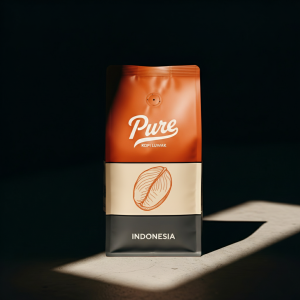
Pure Kopi Luwak
Wild civet coffee from Java. 88.5 SCA cupping score. From $125 for 100g.
Kopi luwak’s reduced bitterness means you can brew it slightly stronger than you might brew a conventional specialty coffee without the cup turning harsh. The enzymatic modifications during civet digestion break down certain proteins that are precursors to bitterness during roasting — which means kopi luwak can be pushed toward the stronger end of the ratio range without the edge you’d get from most other origins at equivalent concentration.
Water Temperature: 93°C (200°F)
The target water temperature for French press brewing is 90–96°C (195–205°F). For kopi luwak, aim for the middle of that range: 93°C (200°F). Too hot (boiling, 100°C) scalds the grounds and over-extracts bitter compounds quickly. Too cool (below 88°C) under-extracts, leaving the cup flat and thin.
If you don’t have a temperature-controlled kettle, bring water to a full boil and let it sit off the heat for 45–60 seconds. At sea level, this drops the temperature to approximately 93–94°C — close enough for consistent results. At higher altitudes, water boils at lower temperatures, so the resting time before brewing should be shorter to stay within the target range.
Grind Size: Coarse, Like Sea Salt
French press requires a coarse grind — particles roughly the size of coarse sea salt crystals, approximately 800–1000 microns. Fine or medium-fine grinds over-extract in the full-immersion environment and push silt through the metal mesh filter. Too coarse and the extraction is weak and watery.
For kopi luwak, grind slightly coarser than you would for a standard French press recipe. Because the beans have undergone partial protein hydrolysis during civet digestion, they extract a little more readily than standard specialty coffee. A fractionally coarser grind compensates for this and keeps the extraction balanced.
Grind immediately before brewing. Kopi luwak’s complex flavor compounds are volatile — they begin oxidizing within minutes of the bean being cracked open. The difference between coffee ground ten minutes before brewing and coffee ground the previous day is not subtle, and it matters more for kopi luwak than for most coffees, because you’re paying for exactly the nuanced flavor that stale grinding destroys first.
Try the coffee this article is about
Wild-sourced from Java, 88.5 SCA cupping score, free US shipping. From $125 for 100g.
Shop Pure Kopi Luwak →The Brew Process: Step by Step
Preheat the French press by filling it with hot water and letting it sit for a minute, then emptying it. This prevents the cold vessel from dropping the brew temperature during extraction. Add your ground kopi luwak. Pour just enough water — roughly twice the mass of the coffee — to saturate the grounds completely. This is the bloom: the carbon dioxide trapped inside freshly roasted beans releases quickly on first contact with hot water, and skipping the bloom causes gas to escape during extraction and interfere with even saturation. Let the bloom sit for 30–45 seconds.
Then pour the remaining water slowly and evenly, targeting the center of the grounds and moving outward in a circular motion. Place the lid on the press with the plunger pulled all the way up. Set a timer for four minutes. At the four-minute mark, press the plunger down slowly and steadily over about 30 seconds — rapid plunging creates turbulence that pushes fine particles through the filter. Pour immediately. Don’t let the coffee sit in the press after plunging: the grounds remain in contact with the liquid and continue extracting, pushing the cup toward over-extraction. For kopi luwak, which you specifically want smooth and balanced, this step matters more than it does for coffees that are already assertively bitter.
What to Expect in the Cup
A well-brewed kopi luwak in a French press produces a cup that is notably full-bodied, low in bitterness, and clean despite the full-immersion method. The body comes from the coffee oils that the metal filter preserves — compounds that paper-filtered methods strip out. The low bitterness comes from the enzymatic modifications during civet processing. Research published in food chemistry literature has documented lower concentrations of malic and citric acids in civet-processed coffee compared to conventionally processed beans from the same origin, which contributes to the smoothness that defines good wild kopi luwak.
The flavor profile of Javanese wild kopi luwak brewed this way tends toward chocolate, earthy depth, and slight sweetness at the finish — the combination of the Arabica cultivars grown in Java’s highland volcanic soil and the enzymatic processing that differentiates it from standard coffee. Understanding why kopi luwak tastes different from conventional specialty coffee provides useful context for interpreting what’s in the cup.
Comparing French Press to Other Methods
The French press is one of several methods that work well with kopi luwak, but each emphasizes different qualities. Pour-over and Chemex brewing — with paper filters — produce a cleaner, lighter cup that highlights delicate acidity and floral notes but sacrifices body. The Chemex method for kopi luwak suits people who prefer transparency over richness. Espresso concentrates the flavors intensely and showcases the smoothness, but requires precise grind calibration and is less forgiving of bean variation.
The French press is the most forgiving of the three and the easiest to dial in. At 23 grams of coffee in a 350ml press at 93°C for four minutes, it gives kopi luwak the conditions it needs to show what a wild-sourced civet-processed coffee from Java’s volcanic highlands actually tastes like — without filters, without shortcuts, and without leaving anything behind.
Pure Kopi Luwak
Wild civet coffee from Java. 88.5 SCA cupping score. From $125 for 100g.

Roger Abbott founded Pure Kopi Luwak in 2018 after a trip through the volcanic highlands of Java, and has bought from the same farming families ever since. He only works with collectors of wild civet coffee, never caged. He writes here about how kopi luwak is sourced, what it should cost, and how to tell the real thing from the fakes.