In 1937, Jamaica’s colonial agricultural department shipped coffee seeds to Papua New Guinea — specifically, plants from the Blue Mountain region that had already built Jamaica’s premium coffee reputation. Those seeds took root in PNG’s Western and Eastern Highlands, where volcanic soils and elevations between 1,400 and 1,800 meters proved ideal for Arabica cultivation. Today, Papua New Guinea coffee employs approximately 2.5 million people and accounts for roughly 1% of world production — a modest global share but a significant national one for a country of nine million people.
That heritage matters, because PNG coffee carries the DNA of one of the world’s most celebrated origins — and still trades at a fraction of what rare coffee commands. Specialty-grade PNG Arabica retails between $4.81 and $8.74 per pound at international market prices, which positions it firmly as serious everyday coffee rather than rare-occasion coffee. Understanding why that’s different from what kopi luwak offers is the core of this comparison.
What Papua New Guinea Coffee Tastes Like
PNG Arabica grown in the Highland provinces — including the Wahgi Valley and the area around Mount Hagen — produces a cup that specialty roasters consistently describe as sweet, clean, and medium-bodied, with tasting notes that include peach, pear, mild citrus, and caramel. The Blue Mountain lineage is occasionally audible in the cup: a certain clean delicacy that differentiates it from Indonesian origins and from the more rustic profiles of some other Pacific coffees. Acidity is moderate and soft rather than bright or sharp.
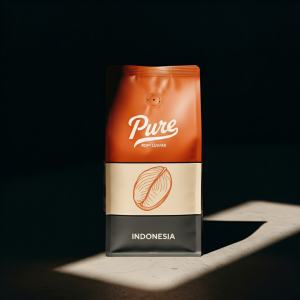
Pure Kopi Luwak
Wild civet coffee from Java. 88.5 SCA cupping score. From $125 for 100g.
Estate-grade PNG coffees — from producers who’ve invested in proper wet processing and careful sorting — can reach $15 to $20 per pound at specialty retail and occasionally appear on café menus as single-origin pour-overs. When the beans are well-handled, the result is genuinely enjoyable: the kind of coffee that earns its place in a specialty roaster’s rotation without requiring much justification.
What PNG cannot claim, and what its price point accurately reflects, is the processing transformation that defines kopi luwak. The beans are grown, harvested, processed, dried, and exported through conventional coffee pathways. They are excellent examples of what good agricultural practice and a favorable growing environment can produce. But they begin and end as conventionally grown coffee.
What Java Kopi Luwak Offers That PNG Cannot
Wild kopi luwak from Java’s highland farms introduces an intervention between cherry and cup that no conventional processing can replicate. Wild Asian palm civets (Paradoxurus hermaphroditus) select individual peak-ripe cherries — their olfactory precision for ripe fruit is documented in field studies across Java’s coffee-growing regions — and pass the consumed beans through a digestive process lasting 12 to 24 hours. During that transit, proteolytic enzymes in the civet’s stomach hydrolyze specific proteins in the bean’s outer layers: proteins that, when left intact, contribute to bitterness during roasting.
Food chemistry research has documented measurably lower concentrations of malic and citric acids in kopi luwak compared to conventionally processed beans from the same origin. The practical result in the cup is a smoothness and reduction in bitterness that goes beyond what any roast profile or water chemistry adjustment can achieve. PNG’s sweetness comes from good growing conditions. Kopi luwak’s smoothness comes from a biological transformation that only a healthy wild animal consuming peak-ripe fruit can produce.
Papua New Guinea’s production declined approximately 8% in 2024, attributed partly to aging coffee trees and market access challenges — a reminder that even established origins face ongoing supply pressures. Wild kopi luwak’s scarcity is structural rather than cyclical: wild civets consume limited quantities regardless of demand, and ethical sourcing means the supply ceiling is defined by what the animals naturally produce, season to season.
The Buying Decision
If you’re building a daily coffee routine around single-origin Arabica with a budget of $10 to $20 per pound, quality PNG estate coffee deserves serious consideration. It’s honest coffee with a real origin story and flavor characteristics that reward careful brewing. The Wahgi Valley producers doing good work are worth seeking out.
If you’re buying for a specific occasion — a gift, a milestone, a deliberate experience — the category changes entirely. Wild kopi luwak from Java at $125 for 100 grams isn’t competing with PNG for daily-driver status. It’s offering something that exists in a separate category: a coffee defined by scarcity, by a biological process that cannot be industrialized, and by a flavor profile that reflects both exceptional origin and an intervention no conventional producer can replicate.
You wouldn’t compare a Burgundy Grand Cru to a reliable Côtes du Rhône by asking which one to drink every morning. The question is which one to open when the moment calls for it. Pure Kopi Luwak, sourced from wild civets on Javanese highland farms, answers that question.
For more on how kopi luwak compares to other premium origins, see the world’s most expensive coffees ranked. For context on Javanese sourcing specifically, Java harvest and kopi luwak scarcity explains the supply dynamics in detail.
Pure Kopi Luwak
Wild civet coffee from Java. 88.5 SCA cupping score. From $125 for 100g.

Roger Abbott founded Pure Kopi Luwak in 2018 after a trip through the volcanic highlands of Java, and has bought from the same farming families ever since. He only works with collectors of wild civet coffee, never caged. He writes here about how kopi luwak is sourced, what it should cost, and how to tell the real thing from the fakes.