In 1554, two Yemeni traders named Hakam and Shams opened what historians record as the first coffeehouse in Constantinople, and within a decade the Ottoman Empire had an institution it would never surrender. Turkish coffee — brewed in a small copper pot called a cezve, unfiltered, consumed in small cups with the grounds settling quietly at the bottom — became so central to Ottoman culture that UNESCO added it to its Intangible Cultural Heritage list in 2013. That’s four and a half centuries of institutional weight. Wild kopi luwak, by contrast, has no cultural institution behind it. It has something rarer: a biological process in the Javanese highlands that no government, tradition, or competitor has managed to replicate.
These two coffees share almost nothing except the name. Comparing them reveals something useful: they’re answering completely different questions.
What Turkish Coffee Is Actually Doing
Turkish coffee answers a specific question: how do you extract the maximum flavor and caffeine from a small amount of ground coffee, as efficiently as possible, using nothing more than a pot and a heat source?
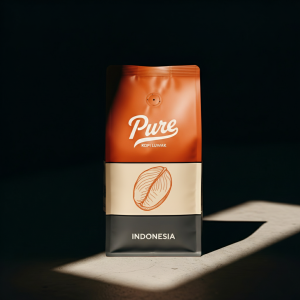
Pure Kopi Luwak
Wild civet coffee from Java. 88.5 SCA cupping score. From $125 for 100g.
The answer is immersion at its most direct. You take finely ground coffee — ground finer than espresso, fine enough it almost resembles flour — and simmer it in cold water in the cezve, never quite reaching a full boil. The grounds are never filtered out. They settle at the bottom of the cup while you drink. The sediment left behind is what fortune tellers read in the tradition of tasseography, still practiced across Turkey, Greece, and Lebanon today.
The caffeine content of a standard 60ml cup sits around 50-65mg — comparable to a single espresso — but the unfiltered grounds mean you’re consuming compounds that a paper filter would remove: oils, fine particulates, and the thick texture that defines Turkish coffee. The flavor is concentrated and unmistakably intense. It’s designed to wake you up, not to be examined at leisure.
What Turkish coffee does brilliantly is extract maximum character from any bean. You can produce a strong, aromatic cup from commodity-grade Arabica. The method carries most of the weight. The bean is almost secondary.
Try the coffee this article is about
Wild-sourced from Java, 88.5 SCA cupping score, free US shipping. From $125 for 100g.
Shop Pure Kopi Luwak →What Wild Kopi Luwak Is Actually Doing
Wild kopi luwak answers a different question entirely: what happens when you remove every shortcut, let a wild animal sort your raw material with more precision than any human harvester, and allow a 12-24 hour biological process to transform the bean before it ever sees a roaster?
The answer begins in a Javanese coffee plantation at night. An Asian palm civet (Paradoxurus hermaphroditus) moves through Arabica trees selecting only peak-ripe cherries — passing over under-ripe and over-fermented fruit with a selectivity that even careful human harvesters can’t consistently match at scale. The cherries pass through the civet’s digestive tract intact. Proteolytic enzymes in the civet’s stomach partially break down proteins in the outer layers of the bean, reducing their bitterness potential in the final cup. Research has documented lower concentrations of malic and citric acids in kopi luwak compared to conventionally processed beans from the same Javanese origin, which explains the coffee’s notably smooth, clean finish.
The result sits at the opposite end of the spectrum from Turkish coffee. Where Turkish coffee pushes intensity to its limit, wild kopi luwak works toward something subtler: full body without heaviness, dark chocolate and earth in the cup, a finish that lingers without sharpness. You brew it the same way you’d brew any good Arabica — a medium-fine grind for pour over, 93°C water. But what arrives in the cup feels different. Calmer. More resolved.
What Each Coffee Asks of You
Turkish coffee asks very little. It’s democratically available, historically ubiquitous, and designed to be drunk quickly at a small table. The serving ritual is elaborate — foam (köpük) maintained on top as a sign of skill, sugar mixed in before brewing rather than after — but the result is genuinely accessible. In Istanbul, people drink it five times a day, not just on weekends when they have time to pay attention.
Wild kopi luwak asks more. It requires a burr grinder, a pour over dripper or a well-calibrated French press, filtered water at the right temperature. It requires a bag that costs $125 for 100 grams. It asks you to treat the cup as an object of attention rather than a quick caffeine delivery mechanism. The payoff is different: not intensity, but complexity. Not speed, but something worth slowing down for.
They’re both coffees for people who care about their morning cup. But they care about completely different things.
The Honest Trade-Off
There’s nothing wrong with Turkish coffee. It’s one of the great brewing traditions in history, and if what you want is a strong, ceremonially prepared cup that connects you to 500 years of social ritual, Turkish coffee delivers it without compromise. It earned its UNESCO heritage status.
But if the question is which coffee rewards the quality of the bean rather than the method of extraction — which coffee gives you something that genuinely cannot be obtained any other way — that’s where the comparison ends cleanly. Turkish coffee’s intensity comes largely from its method. The method does enormous work. You can make strong, complex Turkish coffee from ordinary beans if you grind them fine enough.
Wild kopi luwak doesn’t have that leverage. The quality lives in the bean itself: in the cherry selection by a wild animal, in the enzymatic transformation during digestion, in the specific Arabica cultivars growing on specific Javanese highland farms. You can’t create that effect with a different process or a cheaper starting material. One is a method that makes almost any bean worth drinking. The other is a bean that makes almost any method reveal something extraordinary.
Pure Kopi Luwak is sourced exclusively from wild civets on Javanese farms — whole bean, medium roasted, ships internationally. For more on how wild kopi luwak compares across the premium coffee world, see our Blue Mountain comparison and our ranking of the world’s priciest coffees.
Pure Kopi Luwak
Wild civet coffee from Java. 88.5 SCA cupping score. From $125 for 100g.
Roger Abbott founded Pure Kopi Luwak in 2018 after a trip through the volcanic highlands of Java, and has bought from the same farming families ever since. He only works with collectors of wild civet coffee, never caged. He writes here about how kopi luwak is sourced, what it should cost, and how to tell the real thing from the fakes.