Somewhere on a hillside in East Java, on a night thick with the smell of wet earth and coffee blossom, a single palm civet begins her rounds. She has done this a thousand times. She will do it a thousand more. But tonight, without knowing it, she will set one bean on a journey that ends in a cup half a world away.
The Selector
She moves through the coffee trees the way water moves through a crack — not forcing, just finding the easiest line. Her eyes catch infrared light that human eyes cannot process, and she reads the darkness as easily as a page. She is looking for something specific. Not just any coffee cherry. The right one.
She pulls a cherry from a low branch, turns it in her forepaws, brings it to her nose. It smells almost right. She drops it. A meter further, she pulls another. This one — ripe to the point of almost overripe, its skin taut and yielding at the same moment, its color in her mouth before she has even bitten — this one she eats. The flesh is sweet and fermented-bright. She eats perhaps a hundred cherries over the course of the night, and she does not eat a single unripe one. Her preference is not learned behavior. It is older than that. It is the same instinct that moves bees toward the sweetest flowers and birds toward the most nutritious berries. In a plantation full of coffee cherries at varying stages of ripeness, she selects only the peak. This is not incidental. This is the first step in a flavor process that humans have only recently begun to understand.
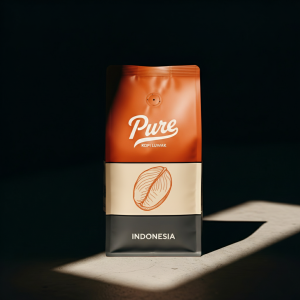
Pure Kopi Luwak
Wild-sourced. Organic. Arabica. From $125.
The bean inside the cherry she has just swallowed is a coffee seed, a Coffea canephora or arabica kernel wrapped in its parchment layer. It descended intact through her esophagus. Now it enters the chamber.
The Chamber
The civet’s digestive system is not designed to destroy a coffee bean. It is designed to extract nutrients from fruit and animal matter, and a coffee bean — hard, dense, wrapped in parchment and silver skin — resists that extraction almost entirely. What happens instead is something more nuanced. Over the course of eight to twelve hours, the bean sits in an environment of controlled biochemical pressure. Protease enzymes seep through the parchment layer and begin to break down short-chain proteins embedded in the bean’s cellular matrix. These proteins are part of what makes coffee bitter. As they degrade, they leave behind a structural change that no roaster can replicate after the fact.
The food scientist Massimo Marcone documented this process in a 2004 study published in Food Research International, finding measurable differences in protein composition between civet-processed beans and conventionally processed ones. The civet’s stomach acids contribute to a further softening of the outer layers, while the extended transit time allows secondary enzymatic reactions to continue that simply do not occur in mechanical or natural processing. The bean that emerges is not the same bean that went in. It carries its time in the chamber the way wood carries a season of drought — invisibly, structurally, in ways that will only reveal themselves later, under heat.
If you want to understand more about the science behind why this process produces such an unusually smooth cup, there is a deeper explanation at the science of kopi luwak’s smooth flavor.
Eventually, the civet deposits what remains. The beans, still wrapped in their parchment, emerge in small clusters on the plantation floor. The civet moves on. The night continues. The bean waits for dawn.
Dawn Rounds
The collector arrives before the heat does. In East Java, the hour just before sunrise has a particular quality — the air holds the coolness of the night and the first suggestion of warmth, and the light comes slowly enough that you have time to see the world before it fully arrives. He walks the rows the way you walk a familiar room in the dark: confident, unhurried, already knowing where the furniture is.
He has learned to read the civet’s preferences almost as well as the civet herself. He knows which parts of the plantation she favors in which season, which trees she returns to, where she rests and where she moves through quickly. He crouches, looks, collects. The bean — still clustered with three or four others in a deposit on the soft soil beneath a coffee tree — goes into a basket lined with cloth. It will be washed within hours. The collector does not linger. There is a full plantation to walk before the heat makes the work unpleasant, and the deposits must be gathered fresh.
This collection process is one of the details that separates genuine wild-civet kopi luwak from the cage-produced version that dominates much of the commercial market. You can read more about what the real thing actually involves at what is kopi luwak. For now, the bean is in the basket, and the basket is heading toward water.
Water and Light
The washing is thorough and repeated. The parchment-covered beans are soaked, scrubbed, rinsed, soaked again. The outer material that clung to them through the night is removed carefully but completely. Clean water, the same water that runs off the volcanic slopes of the Ijen plateau, poured through in successive passes until what remains is odorless and pale. There is something almost ritual about it — not because the workers treat it that way, but because the act itself, the transformation from collected to cleaned, marks a clear before and after.
Then the beans are spread on raised bamboo beds and left to the sun. In the Javanese dry season, the heat is direct and the drying is fast; in the wet season, patience is required. They are turned regularly, lifted and redistributed so that no surface faces the sun too long. The drying is not merely evaporative. As moisture leaves the bean slowly, microbial activity continues inside the parchment — secondary fermentation, subtle and brief, adding aromatic complexity that researchers are only beginning to map. The raised beds ensure airflow beneath as well as above. The bean dries evenly. This takes days. There is no shortcut that does not show up in the cup.
The Hand That Decides
After drying, the beans are milled to remove the parchment layer and then sorted. This is where a human hand makes a decision that no machine can make cheaply or well. An experienced sorter can feel what the eye confirms and the eye confirms what the hand felt — a slightly hollow bean, a cracked one, one that dried unevenly, one that was caught in the wrong part of the deposit and carries some contamination. These are removed. Not because the standards are performed for an audience, but because the whole point of this coffee — its entire justification for existing at a premium — depends on not cutting corners here.
The bean makes the cut. It is dense, intact, its silver skin smooth under a thumb. It passes through the sorter’s hand and falls with the others into the next container. It has now survived the civet, the night, the washing, the drying, and the human inspection. It has one more transformation ahead of it. But that transformation requires fire.
The Roast
The order is placed first. This is not a small distinction. Most coffee sold commercially was roasted weeks or months before it reached the customer. The roast date on the bag is a disclosure, not a boast. Here, the sequence is reversed: the order comes in, and then the roaster prepares the batch. The bean and its companions go into the drum already promised to someone.
As the drum temperature climbs past 150 degrees Celsius, the Maillard reaction begins — the same chemistry that browns bread and sears meat, here working on the sugars and amino acids inside the bean. The green, grassy smell of raw coffee gives way to something warmer. The bean expands slightly as internal moisture converts to steam and forces its way out. Around 196 degrees, the first crack sounds — a series of small pops as the bean’s cellular structure fractures and gases escape. The oils that have been locked inside since the civet’s digestive enzymes rearranged the proteins now begin to migrate toward the surface. The roaster reads the smell, the sound, the color. She pulls the batch at the moment that seems right for what this coffee is: not too light that it tastes raw, not so dark that the character the civet gave it is buried under char.
The beans cool quickly on a perforated tray. The roast is done. For more about what this coffee tastes like and how to order it fresh-roasted, see the product page. The bean goes into a bag that will be sealed with a one-way valve to let CO₂ escape without letting oxygen in. The roast date is printed on the label.
The Door
The bag is weighed, sealed, labeled. A shipping label is generated. Someone at a fulfillment station tucks it into a box with a few grams of tissue paper so it does not rattle. Tape. Barcode scan. The box joins a pile of other boxes going to a sorting facility. It moves through a system that processes tens of millions of packages a day, that has long since ceased to notice any individual item, and in that vast indifferent machinery it travels — by truck, by plane, by truck again — from a warehouse in one climate to a porch in another.
The person who ordered it opens the outer box, pulls out the bag, reads the roast date. It has been less than a week. They put it on the counter. They will open it in the morning.
The Cup
The grinder is set slightly coarser than espresso, slightly finer than pour-over. The beans go in and the aroma that rises before the grinding even starts is already different from most coffee — quieter, less aggressive, with a sweetness underneath that is more like chocolate than fruit. The ground coffee smells like something that has already been taken care of.
Hot water at 93 degrees is poured in a slow spiral. The bloom is generous, the CO₂ release visible, rising for a full forty seconds. Then the rest of the water, slowly. The cup that comes out is a particular shade of amber. The first sip is almost disconcertingly smooth — not thin, but without the harsh edge that most coffee carries and that most coffee drinkers have learned to expect and compensate for with milk or sugar. There is a sweetness that was never added. There is a depth that was never faked.
What is sitting in that cup began on a hillside in East Java, selected by a wild animal in the dark, transformed inside her body over hours, gathered by hand at first light, washed and dried under a volcanic sun, sorted by a human who knew what to look for, roasted to order, and shipped fresh. Most coffee called kopi luwak has not taken this path — as detailed at the problem with fake kopi luwak, the vast majority is produced under conditions that bear no resemblance to what just happened. The improbability of this cup — the number of steps that had to go right, the number of hands and decisions and processes that could have gone wrong — is not a marketing story. It is the actual biography of what you are holding. It is why it tastes the way it does.
Pure Kopi Luwak
Wild-sourced. Organic. Arabica. From $125.
Roger Abbott is the founder of Pure Kopi Luwak. He has spent over a decade sourcing wild kopi luwak directly from farmers and collectors in the highlands of Java, Indonesia — working exclusively with wild civets, never caged. He writes about specialty coffee, Indonesian origins, and the science behind what makes kopi luwak taste the way it does.
