The PREDIMED trial — a landmark Spanish study of more than 7,000 participants published in the New England Journal of Medicine in 2013 — is the most rigorous piece of evidence supporting the Mediterranean diet. What most summaries leave out is the footnote about coffee: the trial’s participants drank it freely, and the researchers did not classify it as incompatible with their dietary protocol. This was not an oversight. Mediterranean eating cultures have never treated coffee as a vice to be moderated. In Greece, Turkey, Italy, Spain, and Lebanon, coffee is part of the rhythm of the day — drunk slowly, in small cups, without apology.
That matters for anyone following the Mediterranean diet who wonders where their morning cup fits.
The Mediterranean diet is, at its core, a framework built around quality over quantity, minimally processed ingredients, and the kind of eating that slows you down enough to actually taste what is in front of you. Olive oil rather than vegetable oil. Whole fish rather than fish sticks. Red wine, in moderation, rather than spirits. The pattern consistently favors things that are close to their original form — and it favors things that come with a story about where they were grown and how they were made.
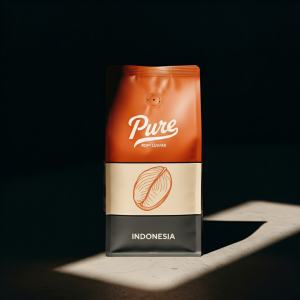
Pure Kopi Luwak
Wild civet coffee from Java. 88.5 SCA cupping score. From $125 for 100g.
Wild kopi luwak fits that framework better than almost any other coffee in existence.
The reason is not the origin story, though the origin story is remarkable. The reason is what happens to the coffee during production. Wild Asian palm civets in the highland forests of Java consume ripe coffee cherries as part of their natural diet. During the roughly 24 to 36 hours of transit through the digestive tract, natural fermentation degrades the proteins that produce bitterness and reduces the chlorogenic acid content — the compound responsible for much of coffee’s acidity and its sharper edge on an empty stomach. What emerges is a bean that has been, in a sense, predigested: stripped of the harsher elements and left with a flavor profile that is measurably smoother and lower in acid than any conventionally processed equivalent.
For someone eating in the Mediterranean style — food that tends to be gentle on the digestive system, high in fiber, low in processed compounds — a low-acid coffee is not a luxury. It is the logical companion to a breakfast of Greek yogurt, fruit, and whole grain bread. It does not arrive in the stomach like a challenge. It arrives like the rest of the meal: deliberate, slow, worth tasting.
A 2023 analysis published in the journal Antioxidants, looking at coffee consumption among participants following a Mediterranean dietary pattern in the Seguimiento Universidad de Navarra cohort, found no adverse metabolic effects from regular coffee consumption when embedded in that dietary framework. The researchers noted that coffee’s polyphenol content — particularly chlorogenic acids, despite being reduced in kopi luwak — likely contributes to the anti-inflammatory properties shared by other Mediterranean staples like olive oil and red wine.
None of which changes the simple fact that a genuinely low-acid coffee is one of the easier upgrades you can make to a Mediterranean-pattern morning. Most people following the diet carefully are already paying attention to what they put in their bodies. They are already making intentional choices about oil, bread, protein. Coffee is often the one area where that intentionality slips — because good coffee is harder to find than good olive oil, and the premium is less legible.
Wild kopi luwak makes the premium legible. The sourcing is specific: wild civets in Java, not caged civets on a farm, not a blend from multiple origins designed to approximate a flavor profile. The smoothness is structural, not corrective — it is not produced by alkalizing the roast or blending out the acidity. It is simply what remains when the fermentation process has done its work on a cherry selected by an animal with no interest in anything other than the ripest, sweetest fruit available.
That combination — wild sourcing, minimal processing, a product that is what it claims to be — is the Mediterranean diet’s entire philosophy applied to a cup of coffee. It is not a supplement. It is not an optimization. It is what coffee looks like when you apply the same criteria you apply to everything else on the table.
If you have built your eating around quality and provenance, Pure Kopi Luwak — wild-sourced from Java, available in 100g and 250g — extends that logic to the one part of the morning you may not have reconsidered yet. The smoothest coffee in the world is not a category invented by marketing. It is what low-acid, wild-fermented, carefully roasted beans actually taste like — and it belongs on a Mediterranean breakfast table.
Pure Kopi Luwak
Wild civet coffee from Java. 88.5 SCA cupping score. From $125 for 100g.
Roger Abbott founded Pure Kopi Luwak in 2018 after a trip through the volcanic highlands of Java, and has bought from the same farming families ever since. He only works with collectors of wild civet coffee, never caged. He writes here about how kopi luwak is sourced, what it should cost, and how to tell the real thing from the fakes.