In August 2025, a lot of Geisha coffee from Hacienda La Esmeralda in Boquete, Panama sold at auction for $30,204 per kilogram — the highest price ever recorded for coffee at that point, according to Forbes. The buyer was a specialty roaster. The purpose was prestige, flavor, and the ability to say they had it. Meanwhile, verified wild kopi luwak from Java has been trading at $1,200-1,800 per kilogram at international wholesale — a fraction of Geisha’s auction peak, but still far beyond what most premium Arabica commands.
When two coffees occupy the extreme upper end of the price spectrum for completely different reasons, comparing them becomes instructive. Not to crown a winner, but to understand what each purchase actually means.
Different Origins, Different Stories
Panama Geisha (also spelled Gesha) traces its origin to a coffee-growing region in Ethiopia near the town of Gesha, where the variety was identified in the 1930s. It was brought to Panama’s Boquete region in the 1960s via breeding programs in Costa Rica. For decades it sat unremarkable in fields — too delicate to yield well, too complex to understand. Then Hacienda La Esmeralda entered it in Panama’s Best of Panama competition in 2004, and it won by a margin that stunned the specialty coffee world. The variety grows at elevations of 1,700-1,800 meters, where volcanic soil and cool nights slow bean development and concentrate the aromatic compounds that make it what it is.

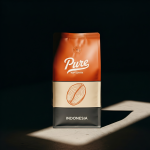
Pure Kopi Luwak
Wild civet coffee from Java. 88.5 SCA cupping score. From $125 for 100g.
Wild kopi luwak from Java is not a variety at all — it’s a process. Asian palm civets (Paradoxurus hermaphroditus) eat ripe coffee cherries in their natural habitat. The proteolytic enzymes in their digestive system modify the bean’s protein structure, reducing bitterness-causing chlorogenic acids and creating a flavor profile that no amount of skilled roasting on a standard bean can replicate. The underlying variety is typically Arabica — Typica or Bourbon — grown in Java’s volcanic highlands. The civet is the processing method.
Flavor: Two Entirely Different Targets
Panama Geisha is spectacularly floral and bright. Expect jasmine, bergamot, mango, mandarin, and a tea-like delicacy that makes most specialty coffees taste blunt by comparison. Its acidity is pronounced but refined — more like a Meyer lemon than a green apple. The body is lighter than you might expect. Drinking a well-sourced Geisha feels like it’s operating at a frequency slightly outside the normal register of coffee.
Wild kopi luwak runs in almost the opposite direction. The civet processing reduces acidity rather than amplifying it. The cup is smooth, earthy, and full-bodied — more bass notes than treble. Bitterness, which characterizes even excellent conventional coffee, is substantially muted. The complexity is subdued rather than explosive: a long, clean finish with depth that reveals itself slowly. Where Geisha announces itself, kopi luwak settles in.
If you love coffee’s brighter, more acidic expression — the wine-world side of the spectrum — Geisha is the more exciting cup. If you find most coffee too sharp and value smoothness and body over brightness, kopi luwak is the more satisfying drink.
Try the coffee this article is about
Wild-sourced from Java, 88.5 SCA cupping score, free US shipping. From $125 for 100g.
Shop Pure Kopi Luwak →What You’re Actually Buying
A typical Panama Geisha from a quality roaster — not auction-lot material, but sourced from a reputable Boquete estate — runs roughly $20-50 per 100g at retail. You’re paying for a genetic variety that produces extremely low yields, grows only at altitude, and commands a market premium built on twenty years of competition wins and specialty media coverage.
Wild-sourced kopi luwak at $125 per 100g is priced differently. The scarcity is supply-side: wild civet activity is finite and uncontrollable, collection is labor-intensive, and verification is both important and difficult. The premium reflects production constraints, not auction hype.
Geisha’s price is partly self-referential — auction lots at $30,000/kg generate headlines that push retail prices for all Geisha upward. Kopi luwak’s price is structural: this is what it costs to produce and verify the real thing. Understanding how to identify a transparent kopi luwak seller is essential, because the gap between genuine wild-sourced product and farmed imitations is significant both ethically and in the cup.
For the Serious Coffee Buyer
Some buyers treat these coffees as sequential milestones: you discover specialty coffee, then single origins, then competition-winning lots, then rare processed coffees, and at some point you try both Geisha and kopi luwak and find out which direction you actually lean.
The honest answer is that most people who love Geisha also find kopi luwak interesting — not necessarily better, but categorically different in a way that’s worth experiencing. And vice versa. These are coffees that reward the buyer who’s past the point of asking “which one should I get” and has moved on to “I want to understand both.”
Kopi luwak’s profile pairs well with the brewing methods that amplify body and minimize acidity: French press, Moka pot, or a well-calibrated pour over with a finer grind. Geisha typically shines brightest in pour over or Aeropress. Brewing errors affect both significantly, but in different ways — under-extraction tends to flatten kopi luwak, while over-extraction turns Geisha bitter.
The Comparison That Isn’t
Asking whether Panama Geisha or wild kopi luwak is “better” is a category error. They’re premium for different reasons, rare by different mechanisms, and satisfying in different ways. The Hacienda La Esmeralda auction price tells you something real about the coffee world’s appetite for flavor transparency and origin prestige. Wild kopi luwak’s price tells you something equally real about biological scarcity and the limits of what verified small-batch production can deliver.
What both coffees share is a resistance to being casual. You don’t reach for either one in a hurry. You brew them with attention, drink them without distraction, and pay enough for them that the experience gets filed somewhere important. That’s what they have in common, and it’s enough to make comparing them worthwhile.
Pure Kopi Luwak
Wild civet coffee from Java. 88.5 SCA cupping score. From $125 for 100g.

Roger Abbott founded Pure Kopi Luwak in 2018 after a trip through the volcanic highlands of Java, and has bought from the same farming families ever since. He only works with collectors of wild civet coffee, never caged. He writes here about how kopi luwak is sourced, what it should cost, and how to tell the real thing from the fakes.