Before the coffee reaches water, before any extraction takes place, the bag tells you what you’re about to brew. Experienced tasters know this well enough to form a preliminary assessment from smell alone. The Specialty Coffee Association’s cupping protocol assigns evaluation points to dry fragrance — grounds before any water is added — as a distinct quality criterion. These aren’t courtesy scores. Aromatic compounds are among the most sensitive indicators of processing quality, roast precision, and freshness. And in kopi luwak, they tell you something specific.
Wild kopi luwak has a distinctive aroma profile that can be characterized with reasonable consistency in high-quality samples. It isn’t identical across producers or harvests — terroir, civet diet, roast level, and time since roasting all contribute. But there are recurring characteristics in genuinely wild-sourced Javanese kopi luwak that appear reliably in quality samples. Knowing them helps you assess what you’re holding before a single drop has brewed.
The Chemistry That Creates the Smell
The aroma of any roasted coffee is generated during the Maillard reaction and caramelization that occur between roughly 150°C and 200°C in the roasting drum, producing hundreds of volatile organic compounds from the transformation of sugars, amino acids, and organic acids in the green bean. But the specific volatile composition depends on what’s in the green bean going in — and civet digestion changes that profile measurably before the bean reaches any roaster.
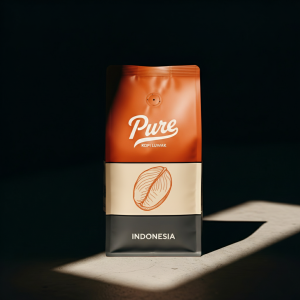
Pure Kopi Luwak
Wild civet coffee from Java. 88.5 SCA cupping score. From $125 for 100g.
Research published in PMC analyzing kopi luwak’s aromatic compound profile found that furans and pyrans were the dominant volatile class, at approximately 40% of the composition, followed by alcohols at 14.7% and pyrazines at 13.3%. Gas chromatography work comparing roasted kopi luwak with standard Arabica found elevated concentrations of pyrazines, furans, and guaiacol derivatives in the kopi luwak samples. A GC-MS study identified maltol and 2,5-dimethylpyrazine as volatile compounds that can chemically distinguish kopi luwak from conventionally processed Arabica beans.
What this means in the cup: pyrazines produce nutty, roasted depth. Furans contribute sweet caramel and fruity notes. Guaiacol derivatives add warm, slightly smoky complexity. Maltol, familiar from caramelized foods, amplifies sweetness perception without adding sweetness. Taken together, these elevated concentrations explain why genuinely wild kopi luwak has a nose that reads as richer, deeper, and more layered than standard Arabica of the same origin roasted to the same profile.
The digestive enzymes in the civet’s gut also alter the amino acid composition of the bean by breaking down storage proteins into shorter peptides. This changes the precursors available to the Maillard reaction during roasting — which changes the volatile compounds produced, and therefore the aroma of the finished roasted bean.
Try the coffee this article is about
Wild-sourced from Java, 88.5 SCA cupping score, free US shipping. From $125 for 100g.
Shop Pure Kopi Luwak →What Wild Kopi Luwak Actually Smells Like
Open a freshly roasted bag of authentic wild kopi luwak and the first impression is of depth rather than brightness. There is no sharp citrus lift of the kind that characterizes a well-processed Ethiopian natural or a washed Kenyan. Instead: earth, dark chocolate, something faintly savory underneath, and a warmth that expands as grounds warm in your hand.
The earthiness is mineral and clean — a characteristic of volcanic-soil Indonesian Arabica grown at elevation — not musty or stale. If the sample smells of wet cardboard or old wood, that indicates a storage problem or over-aged beans rather than anything characteristic of the origin or process. Clean earthiness and stale mustiness are genuinely different smells, and the distinction is learnable with a few reference points.
When ground, the character intensifies and the chocolate note moves forward. There is often a dried-fruit element — fig, raisin, tamarind — that doesn’t announce itself immediately but becomes apparent 30 to 45 seconds after grinding, as freshly cut surfaces off-gas volatile compounds. This short window of maximum aromatics is why specialty coffee professionals insist on grinding immediately before brewing. The difference between beans ground five minutes ago and beans ground five hours ago, in terms of aromatic intensity, is not subtle. With a premium bean, it’s substantial.
What Poor-Quality Kopi Luwak Smells Like
Caged-civet kopi luwak — or conventionally processed coffee sold under the kopi luwak label — tends to have a flatter, more predictable nose. The caramel and chocolate notes may be present at a surface level, but the depth is absent. It smells more like a competent medium-dark Arabica than something unusual.
Some fraudulent or low-quality kopi luwak carries a faintly acrid edge — a sign of over-roasting deployed to obscure deficiencies in the underlying bean. Aggressive roasting masks the complexity (or absence of complexity) in under-ripe or poorly processed coffee. If the aroma is predominantly smoke with little nuance behind it, something was roasted dark for a reason that has nothing to do with your preferences.
The other warning sign is a muted, flat character throughout. Genuine wild kopi luwak, even at moderate freshness, has aromatic persistence — you can detect it at distance when the bag is open. Flat, weak aromas in what’s supposed to be a premium coffee suggest stale beans, processing deficiencies, or a product that’s not what the label describes.
Using Aroma as a Routine Quality Check
Before brewing each cup of your kopi luwak, take five seconds to smell the freshly ground coffee. Hold grounds in your cupped hand, breathe across them slowly, and let the volatiles reach you at distance before bringing them close. What you detect will calibrate your expectation for what you’re about to brew — strong, complex aromatics signal a fresh roast; quieter, one-dimensional notes signal aging.
The aromatic and flavor profiles of coffee track closely, and this brief assessment before brewing is more useful information than any descriptor on a label. With expensive beans in particular, knowing where you are in the freshness window helps you decide whether to adjust your brew parameters for a less volatile extraction or drink what you have without hesitation.
Coffee professionals do this as routine information-gathering, not as ritual. With a premium bean at this price point, five seconds of attention before brewing is a reasonable investment.
For more detail on what wild kopi luwak’s processing changes chemically, see our post on how civets select coffee cherries and our overview of the complete flavor profile.
Pure Kopi Luwak
Wild civet coffee from Java. 88.5 SCA cupping score. From $125 for 100g.

Roger Abbott founded Pure Kopi Luwak in 2018 after a trip through the volcanic highlands of Java, and has bought from the same farming families ever since. He only works with collectors of wild civet coffee, never caged. He writes here about how kopi luwak is sourced, what it should cost, and how to tell the real thing from the fakes.