In 2004, food scientist Mauro Marcone published a study in Food Research International comparing the chemical composition of Indonesian palm civet coffee with regular Arabica beans. In the opening section, he named the coffees that had historically commanded premium prices in the specialty market: Jamaican Blue Mountain and Tanzanian Peaberry were his reference points — two origins that had earned reputations distinct enough to survive decades of market hype. His purpose was to ask whether kopi luwak belonged in that company, and whether its chemical profile justified the price.
More than twenty years later, the comparison is worth making directly. Both kopi luwak and Tanzanian Peaberry occupy a tier of coffees that serious buyers consider before committing at the premium end. They are not competing products — they have almost nothing in common except that both reward careful attention. But understanding how they differ is exactly the kind of knowledge that turns a $125 purchase into a confident one.
Where Each Coffee Comes From
Tanzanian Peaberry is grown primarily on the slopes of Mount Kilimanjaro and Mount Meru in northern Tanzania. The Kilimanjaro Plantation, one of the most recognized estates, has been cultivating Arabica Bourbon coffee at elevation since 1955, when missionaries first established the varietals that define the region’s character. The coffee grows between 1,400 and 1,800 meters in volcanic soil, with the temperature variation that slows cherry development and concentrates sugar accumulation.
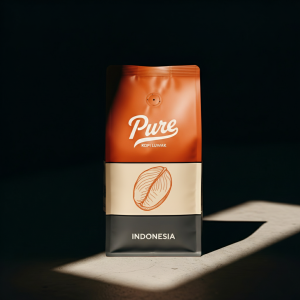
Pure Kopi Luwak
Wild civet coffee from Java. 88.5 SCA cupping score. From $125 for 100g.
Wild kopi luwak from Java follows a different geography entirely. The beans originate on smallholder farms in the Javanese highlands, where Arabica Typica grows under shade canopy. But the processing step that defines it — digestion through an Asian palm civet — has no equivalent anywhere else in coffee. The geographic origin matters, but it is secondary to the transformation the bean undergoes after the civet selects and eats the ripe cherry.
The Peaberry Distinction: What It Actually Means
A peaberry is a natural mutation, not a cultivar or a processing method. Normally, a coffee cherry contains two seeds that develop facing each other, each flattening on the interior side. In roughly 5 to 10 percent of any harvest, a cherry contains only one seed, which grows round and dense rather than flat. Without competition for space or nutrients, the single bean is thought to develop more concentrated flavor — though specialty coffee professionals debate how much of this is chemistry versus received wisdom.
What is less debated is the flavor profile of Tanzanian Peaberry at its best. Coffee Review has described high-end Tanzania lots as exhibiting “honey, orangy citrus, roasted cacao nib, dark fruit — plum and black cherry — hints of flowers.” That fruit-forward brightness with a cacao finish is characteristic: clean, high, alive, with the kind of citric lift that suits people who prefer their coffee like a well-made Kenyan but with a slightly softer edge.
Try the coffee this article is about
Wild-sourced from Java, 88.5 SCA cupping score, free US shipping. From $125 for 100g.
Shop Pure Kopi Luwak →The Kopi Luwak Distinction: What the Civet Changes
Wild kopi luwak’s flavor profile sits at the opposite end of the spectrum from Tanzanian Peaberry. Where the Kilimanjaro coffee is bright and fruit-forward, genuine wild kopi luwak from Java is full-bodied, earthy, and notable above all for its smoothness. The civet’s proteolytic enzymes break down the proteins in the bean that are precursors to bitter Maillard compounds during roasting, producing a cup measurably lower in bitterness than any conventionally processed Arabica of equivalent origin.
The flavor notes are chocolate-dominant: dark cocoa, dried fruit in the background, a caramel finish, and an earthiness that reads as forest floor or aged wood rather than char. It is a heavier cup — fuller in body, less acidic, with a warmth that persists as it cools. If Tanzanian Peaberry is a morning walk in highland air, wild kopi luwak is an armchair after dinner.
The Price Comparison
Tanzanian Peaberry is premium in specialty coffee terms — typically retailing at $20 to $40 per pound from quality roasters. It occupies the upper tier of accessible specialty coffee: something you seek out deliberately but that doesn’t require the same commitment as a rare-animal-processed coffee.
Wild kopi luwak operates in a different economic category. At $125 per 100g, it converts to roughly $567 per pound — an order of magnitude above Tanzanian Peaberry, and priced that way because of the rarity of wild collection, the significant fraud risk in the market (most kopi luwak sold globally is either cage-farmed or counterfeit), and the irreplaceable production constraint of depending on free-ranging animals to choose and process each cherry.
The question is not which coffee is “better” in any absolute sense. They are built for different moments and different palates. Tanzanian Peaberry is the right answer if you want high-quality specialty coffee with a distinctive regional character at a price that allows daily brewing. Kopi luwak occupies a different category entirely — one where the production story, the scarcity, and the singular flavor profile justify a price that positions it closer to a luxury experience than a daily cup.
Which One to Buy
If you are buying for a committed specialty coffee drinker who appreciates brightness, fruit notes, and high-altitude African terroir, Tanzanian Peaberry is a genuine and accessible pleasure at $20 to $40 per pound. If you are buying for someone who wants the rarest coffee in the world — something they will remember, brew deliberately, and offer to guests as a conversation piece — wild kopi luwak from Java is in a category of its own.
Both coffees reward attention. One rewards it at a price that allows daily attention. The other rewards it with an experience you will have eight to twelve times from a single bag, each cup measured out with the awareness that there is a finite number of them. That is a different kind of value, but it is genuine value — and it is the kind that most buyers who reach the premium end of the coffee market are actually looking for.
Pure Kopi Luwak
Wild civet coffee from Java. 88.5 SCA cupping score. From $125 for 100g.

Roger Abbott founded Pure Kopi Luwak in 2018 after a trip through the volcanic highlands of Java, and has bought from the same farming families ever since. He only works with collectors of wild civet coffee, never caged. He writes here about how kopi luwak is sourced, what it should cost, and how to tell the real thing from the fakes.