When Glassdoor surveyed 1,000 U.S. employees and employers about workplace gifting, 53% of employees said they appreciated receiving gifts from their employer. The number that did not make the headline: 81% of those same employees said they would prefer an experience or something personal over a gift card. Gift cards account for roughly 40% of all corporate gifting spend in the U.S. market. They are the most common type of corporate gift and the one employees consistently rank lowest in perceived thoughtfulness. The market has known this for years. The market has continued not to care.
This creates a straightforward opportunity. A $125 bag of wild kopi luwak from Java has a story, a physical presence, and a specificity that gift cards actively lack. It fits standard corporate gift budgets. It ships individually to distributed teams. And it generates a response that a Visa card in a branded envelope will never produce.
The Budget Makes Sense Without Calculation
Standard corporate gift budgets in the U.S. run from $50 for recognition-level gifts to $200 for client appreciation and executive recognition, with $75 to $150 representing the bulk of actual per-recipient spend. A 100-gram bag of wild-sourced kopi luwak at $125 sits directly in the middle of that range — no special approval required, no exception needed.
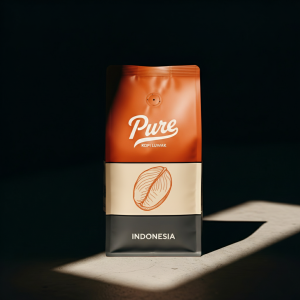
Pure Kopi Luwak
Wild civet coffee from Java. 88.5 SCA cupping score. From $125 for 100g.
The ROI case is separate from the budget case, and stronger. A gift card is spent, forgotten, and gone. Wild kopi luwak produces approximately 10 to 15 cups, each of which is an occasion — a morning when the recipient brews something genuinely different and connects that experience to whoever sent it. The associative value of a memorable coffee gift outlasts the last cup by months. That is not a claim you can make about a restaurant gift card used on a Tuesday lunch two weeks later.
What Makes This Work for Remote Teams
Remote work has restructured the geography of corporate gifting. As of 2024, approximately 40% of U.S. knowledge workers were at least partially remote, with many distributed teams spread across time zones where a unified in-person gift experience is logistically impossible. A physical gift that ships individually to each recipient and creates a shared experience that does not require physical co-location is exactly what distributed teams need.
A bag of wild kopi luwak, sent to each member of a distributed team with a card explaining what they are receiving and why, creates exactly that. When three team members mention the same coffee on Monday’s call — one in Chicago, one in Austin, one in Amsterdam — the gift has done something that a gift card fundamentally cannot: it created a shared conversation across geography. That is the mechanism, not a side effect.
The Story Does the Heavy Lifting
Asian palm civets on Javanese highland farms select peak-ripe Arabica cherries by smell, passing over under-ripe or fermented fruit. A single wild civet might consume 50 to 100 cherries in a night’s foraging, each evaluated individually. The beans pass through the digestive tract over 12 to 24 hours while proteolytic enzymes modify the protein structure, reducing bitterness and organic acid content in ways documented in the 2023 PMC metabolomics study (PMC9960232). Production from wild civets on a single farm is counted in kilograms per season, not tonnes.
That is the story you are attaching to a professional relationship when you send a bag. It communicates something about how you source, what you pay attention to, and what you think is worth the premium. In a gifting context, those messages are not trivial. They are the difference between a gift that says “we remembered you” and one that says “we thought about what you would actually value.”
The Quarterly Milestone Case
Wild kopi luwak works across corporate gifting contexts — client appreciation, team recognition, executive gifting — but it performs particularly well as a quarterly milestone gift because of shelf life. A properly sealed, whole-bean bag stored in a cool, dry place retains its character for four to six months. A Q3 gift sent in September is still at full quality in November. Compare this to fresh baked goods (2-3 days), flowers (one week), or fine chocolates (4-6 weeks optimal). The bag does not rush the relationship.
For client relationships specifically, a bag of kopi luwak sent in October with a note about the Javanese harvest season and the civet’s role in production sits on the recipient’s desk until they open it, and gives them a story to tell when they do. That story connects back to you. No restaurant gift card has ever done that.
What to Include to Make It Land
A bag of wild kopi luwak sent without explanation is a good gift. A bag sent with a card explaining the civet’s selectivity, the Javanese origin, and what makes it different from any other coffee at any price is an excellent one. Include a brew recommendation: pour-over at 93C/199F, medium grind, 2:30 to 3:00 extraction. Most recipients will have a French press or drip maker that also works. Encourage them to drink it black — the lower bitterness means they probably can.
For the full professional gifting context, the corporate gifting overview covers positioning and use cases in detail.
Pure Kopi Luwak
Wild civet coffee from Java. 88.5 SCA cupping score. From $125 for 100g.

Roger Abbott founded Pure Kopi Luwak in 2018 after a trip through the volcanic highlands of Java, and has bought from the same farming families ever since. He only works with collectors of wild civet coffee, never caged. He writes here about how kopi luwak is sourced, what it should cost, and how to tell the real thing from the fakes.