Cal Newport published Deep Work in 2016, and within three years the phrase had entered the vocabulary of anyone who’d spent serious time thinking about knowledge work. The core argument: cognitively demanding tasks that require full concentration produce disproportionate output compared to shallow, reactive work, and most people’s environments — designed for constant communication and immediate availability — actively undermine their capacity for it.
Newport describes deep work sessions as typically lasting 90 minutes, which aligns with the ultradian rhythm first described by sleep researcher Nathaniel Kleitman in 1963. Kleitman observed that the human brain oscillates between high-focus and lower-focus states roughly every 90 minutes throughout the day, not just during sleep. The first 90-minute deep work block of the morning — beginning 60 to 90 minutes after waking, when the brain’s adenosine has been cleared by sleep and cortisol is at its natural daily peak — is the most valuable cognitive real estate in the day.
What you drink in the 20 minutes before that block begins matters more than most people give it credit for.
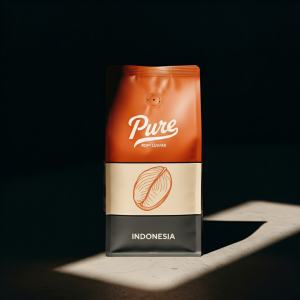
Pure Kopi Luwak
Wild civet coffee from Java. 88.5 SCA cupping score. From $125 for 100g.
What Caffeine Actually Does
Caffeine’s primary mechanism is adenosine receptor antagonism: it binds to the same receptors where adenosine (the brain’s fatigue signal) would normally dock, blocking the sleepiness signal without eliminating adenosine itself. When the caffeine clears, adenosine floods back in — the “crash.” More importantly for deep work, caffeine also increases dopamine and norepinephrine signaling, which enhances mood, focus, and the subjective experience of motivation that makes sitting down to hard cognitive work feel possible rather than painful.
The problem with standard coffee for deep work is not caffeine itself — it’s the secondary effects of high-acid, high-bitterness coffee consumed in the specific physiological context of the morning fasted brain. Organic acids in conventionally processed Arabica stimulate gastric acid secretion. The resulting gastric distress, minor as it may seem, creates background noise in the gut-brain axis that competes with the focus you’re trying to establish. The brain receives caffeine’s “wake up and focus” signal on the same channel as the stomach’s “something is wrong” signal, and the two fight each other.
Try the coffee this article is about
Wild-sourced from Java, 88.5 SCA cupping score, free US shipping. From $125 for 100g.
Shop Pure Kopi Luwak →The Compound Profile Difference
Wild kopi luwak from Java’s highlands arrives at your cup with a different compound profile than conventionally processed Arabica from the same origin — not because of roasting or brewing adjustments, but because of what happens in the gut of an Asian palm civet over 12 to 24 hours of bean transit. Proteolytic enzymes partially hydrolyze proteins that become bitter compounds under roasting heat. Malic and citric acids are reduced compared to identical-origin conventional beans, as documented in research published in Food Research International. The surface chemistry of the bean is altered in ways that change how flavor and physiologically active compounds develop during brewing.
The practical result: a cup with the same caffeine delivery as other Arabica coffees (roughly 1.2 to 1.5 percent caffeine by dry weight) but substantially lower acid and bitterness content. For deep work specifically, this means the adenosine blockade and the dopamine/norepinephrine enhancement arrive without the competing gastric and bitterness signals that standard coffee generates.
The focus experience some kopi luwak drinkers describe — a sense of clarity they don’t associate with other coffees — is not magic. It’s the absence of interference. When the thing you’re optimizing for is a clean cognitive signal with minimal physiological noise, a coffee that removes the noise without removing the signal is doing real work.
The Ritual as a Cognitive Tool
There’s a second mechanism that’s less biochemical and more behavioral. Deep work requires what Newport calls “rituals” — deliberate pre-work routines that prime the brain to shift from reactive, low-attention mode into concentrated focus. The specificity of the ritual matters: the same action performed consistently becomes a Pavlovian cue that helps the brain recognize we’re about to do concentrated work.
Brewing wild kopi luwak — particularly via a pour-over method that requires four to five minutes of patient, precise attention — is itself a form of focused practice before the main event. You’re measuring, timing, pouring, attending to temperature and bloom and drawdown rate. The cognitive mode that pour-over brewing requires is a scaled-down version of the cognitive mode that deep work requires. The transition is smoother than going directly from scrolling your phone to a blank document.
The coffee’s unusual origin — civet-processed beans from a Javanese highland farm, collected from the forest floor — gives it a narrative quality that standard coffee lacks. You know something specific about what you’re drinking and why it tastes the way it does. That specificity is part of what makes it a genuine ritual rather than a generic habit.
Practical Notes for Deep Work Practitioners
Time the brew to finish 10 to 15 minutes before you begin working. The caffeine onset takes 15 to 30 minutes to peak in most people; brewing and drinking at the same time as you open your document means you’re not getting the benefit during the hardest part of the session’s beginning.
Brew with a pour-over method rather than a machine if deep work is the goal. The four-minute manual process is part of the pre-work ritual; an automatic machine skips it. A Chemex or V60 both work well. An AeroPress works for faster mornings when the ritual needs to be shorter.
One cup before the session, no second cup during. The urge to refill during a 90-minute deep work block is usually a sign of distraction — a physical reason to stop and do something else. Removing the option by brewing a single excellent cup before sitting down keeps the cognitive path clear.
Don’t check email between brewing and sitting down. The ritual works as a transition specifically because it separates reactive mode from focus mode. If the pour-over is followed by fifteen minutes of inbox management, the transition is broken.
The argument for wild kopi luwak as a deep work coffee is ultimately a compound one: better compound profile means less physiological noise; more expensive and specific means more conscious and intentional ritual; better flavor means the reward structure is clearer. If the first 90 minutes of your morning is the most productive work you’ll do all day, the coffee you drink before it is not a trivial variable.
Pure Kopi Luwak
Wild civet coffee from Java. 88.5 SCA cupping score. From $125 for 100g.

Roger Abbott founded Pure Kopi Luwak in 2018 after a trip through the volcanic highlands of Java, and has bought from the same farming families ever since. He only works with collectors of wild civet coffee, never caged. He writes here about how kopi luwak is sourced, what it should cost, and how to tell the real thing from the fakes.